Posts Tagged ‘frontier college’

drunk

Posted: October 8, 2015 in rolli
Tags: , , , ,

rolli

I can’t remember why I started drinking, even. I used to be able to remember. Then I forgot.
“You should see a therapist,” Janice told me. My sister.
“It’s not that big a problem,” I said. “Not yet.”
Janice grabbed my neck.
“Just go. It worked for Dad. And for Mom. Do you want to end up like Biscuit?”
I stared at the table.
I was pretty drunk.
We finished our drinks.
On the way out, I grabbed Janice’s neck. Or I would’ve fallen down.
I apologized.
“Thanks for breakfast,” she said.

Mom let me taste her margaritas. Growing up. Just one sip from each one. She could knock back quite a few.
“Doesn’t that taste awful?” she always said.
I always answered, “Yes.”
“So you’ll never drink them when you’re older?”
I always said “No.” Every time.
One night, coming back from a friend’s, I found my dad lying on his back on the lawn.
I helped him up. It was minus twenty.
“You forget how cold snow gets,” he said.
I helped him to the bedroom.
Mom was lying on the bedroom floor.
Biscuit and I picked her up and lay her on the bed next to Dad.
She opened her eyes for a second.
“Don’t tell my kids I was drinking,” she whispered.

Dr. Hollowood looked the part. He had hardly any hair, just a few scratches on the side. And glasses.
Though his office wasn’t like I’d pictured. There were no bookshelves or sumptuous carpets. There was no couch. There was a chair.
“Why do you drink?” he asked.
“I have no idea,” I said.
“Try to think.”
I thought as hard as I could. I was drunk.
“What are you thinking of?”
“What was the question again?”
We talked for maybe half an hour.
Dr. Hollowood looked at his watch.
“That’s all the time we have today. It’s my daughter’s wedding.”
I was wondering about the tux.

The saddest people in the world get together every morning. They wait in line for the liquor store to open.
I know most of them, though not really.
I was waiting in line.
The woman at the front of the line kept rubbing her face.
There was a young guy by the door. Sitting behind an empty guitar case. He didn’t have a guitar. I guess he was hoping for the best.
“It’s 10:01,” said the woman at the front, tapping on the glass.
The door opened.
On my way in, I tossed a quarter into the guitar case.
The guy looked up and smiled.
He still had a few good teeth.

Dr. Hollowood crossed his legs.
“Did you have a happy childhood?”
I knew he was going to say that.
“It was pretty happy, yeah.”
“You mentioned your parents were both alcoholics?”
“Yeah.”
“I guess I was happy anyway. I was a kid. It’s strange how that works.”
“How do you mean?”
“Well… You’re unhappy as a kid. But you’ll never be that happy again.”
Dr. Hollowood touched his chin.
The door opened. A man ran into the room.
“It happened again,” he said.

I met Janice for lunch.
It was May 23rd. I hoped she wouldn’t remember.
“You’re looking better,” she said.
“I’ve had maybe one or two drinks,” I said proudly.
I’d actually had three.
I hadn’t been that sober in a long time.
Janice looked wistful. She poked her spaghetti wistfully.
“You know, it’s been ten years.”
I knew she was going to say that.
“Hard to believe it. Ten years since—”
“I’ve gotta go,” I said, getting up. “See Dr. Hollowood.”
I grabbed my coat.
Janice rubbed my hand.
“Lunch is on me,” she said.

It was just about 10:00.
The woman at the front of the line was trying to rub her face off.
The guy behind the guitar case was sleeping.
The door opened.
When I got to the door, I stopped.
“I don’t want to do this anymore,” I said out loud.
I tossed two quarters into the guitar case.
The guy didn’t even wake up.

When I was seventeen and he was nineteen, my brother was driving us home from a party. We’d both been drinking. A car jumped over the median and hit us.
I remember … we were upside down.
I undid my seatbelt and fell down.
I undid Biscuit’s seatbelt and he fell down.
They think his neck was broken already.

Dr. Hollowood and I went golfing.
The first swing, I sliced pretty bad.
Dr. Hollowood lined himself up.
“It’s a matter of confidence,” he said. “Imagine the greatest golfer in the world. You’re him—only you’re better.”
He swung.
The ball landed right on the green.
I tried it. I imagined I was the best golfer in the world. I don’t really follow golf. I thought of Jack Nicklaus.
I hit the ball.
I hooked it, this time.
“Now you’re overconfident,” said Dr. Hollowood, laughing.
I lifted my club like I was going to smash it.
“You know what,” I said. “That’s it. Maybe that’s it. My drinking. My confidence. I basically have zero confidence.”
“Genetics is also a strong factor,” said Dr. Hollowood.
“You’re probably right,” I said.

I met Janice for dinner. It was my turn to pay—usually I’d pick someplace cheap—but I was saving so much by hardly drinking, I thought what the hell. We ate at Chez Pedro.
“You look great,” said Janice.
“I’m sober,” I said. I was.
A taco shouldn’t cost $30. I ate it slowly.
Janice stared at the table.
“I’ve got some flowers in the car,” she said. “You … want to come?”
“No,” I said. “I can’t deal with it.”
“No problem,” she said. “I understand.”
I stared at the table.
“What the hell,” I said, looking up. “Let’s go.”
Janice smiled.

There’s a ritzy cemetery downtown. Biscuit’s buried in the cemetery across from it.
Most of the headstones are pretty small and cheap. When I saw how shitty Biscuit’s looked in comparison—I’d never been there—my parents didn’t have a lot of money—I cried, just about. It was just an iron bar. The across part had fallen off.
Janice put the flowers down and cried.
I felt horrible. I needed a drink.
I hugged her.
It was bad.
It wasn’t that bad.

I saw Dr. Hollowood once a month. He recommended three times, but that’s a lot of money.
I had an appointment.
I was waiting to cross the street.
“Is my zipper open?” said the guy beside me.
It wasn’t.
He looked down.
“Is my dick out?”
I shook my head. A couple times.
He looked horrified.
“Then that means … I just pissed myself.”
I didn’t even laugh. It could’ve been me.
It was me. Just a few months ago.

I haven’t gotten drunk in a year. I haven’t had a drink in six months.
It’s not a long time.
It’s a long time.
One morning, walking past the liquor store, I was barely even tempted, I saw the guy with the case. He had a guitar now, too.
I’m not sure why. But I smiled.

Rolli  is a writer and cartoonist from Regina, SK, Canada. He’s the author of two short story collections (I Am Currently Working On a Novel  and God’s Autobio), two books of poems (Mavor’s Bones and Plum Stuff), the middle grade story collection Dr. Franklin’s Staticy Cat and two forthcoming novels – Kabungo (Anansi/Groundwood, 2016) andThe Sea-Wave (Guernica Editions, 2016). As a creative columnist for The Walrus, Rolli publishes a new short story and cartoon every week at thewalrus.ca. His cartoons appear regularly in The Wall Street JournalReader’s Digest, Harvard Business Review, Adbusters and other popular outlets. Visit Rolli’s website and follow him on Twitter @rolliwrites.

♦♦♦

Up Next:

howard“Anything else you were supposed to do?”

ruthig

This list of scribbles, once folded
in the middle. A Hansel-Gretel map
of seven words that won’t add up.

It doesn’t say what necklace –
whether to choose, to return,
or have the broken made whole.

And what of the book? Did you
find it, skim a few pages, skip
ahead, decide it wasn’t for you?

Did the title trigger a plan
to run full tilt and dodge
the danger of staying in place?

Your list, if it escaped a pocket or
negligent hand, fell prey to the ditch,
the rough undergrowth of town.

Days outside claimed their toll,
rendered this scrap a relic
whose glyphs baffle and fade.

Maybe you let go on purpose
and reached for better that day –
a story you could read to the end.

Ingrid Ruthig lives on the shore of Lake Ontario, and just east of Toronto. She is the author of Slipstream, Synesthete II, and editor of The Essential Anne Wilkinson and Richard Outram: Essays on His Works. Her work has appeared widely in many Canadian and international publications, including The Best Canadian Poetry, Numéro Cinq, The Malahat Review, and National Post. As a visual artist, she alters existing print language and image to create a fusion in her award-winning textworks, which have been shown in various galleries and are held in private collections. A volume of Ingrid’s poems will be published by Fitzhenry & Whiteside in April 2016.

She can be found at ingridruthig.com

♦♦♦

Up Next:

rolli“One night, coming back from a friend’s, I found my dad lying on his back on the lawn.”

hahnel


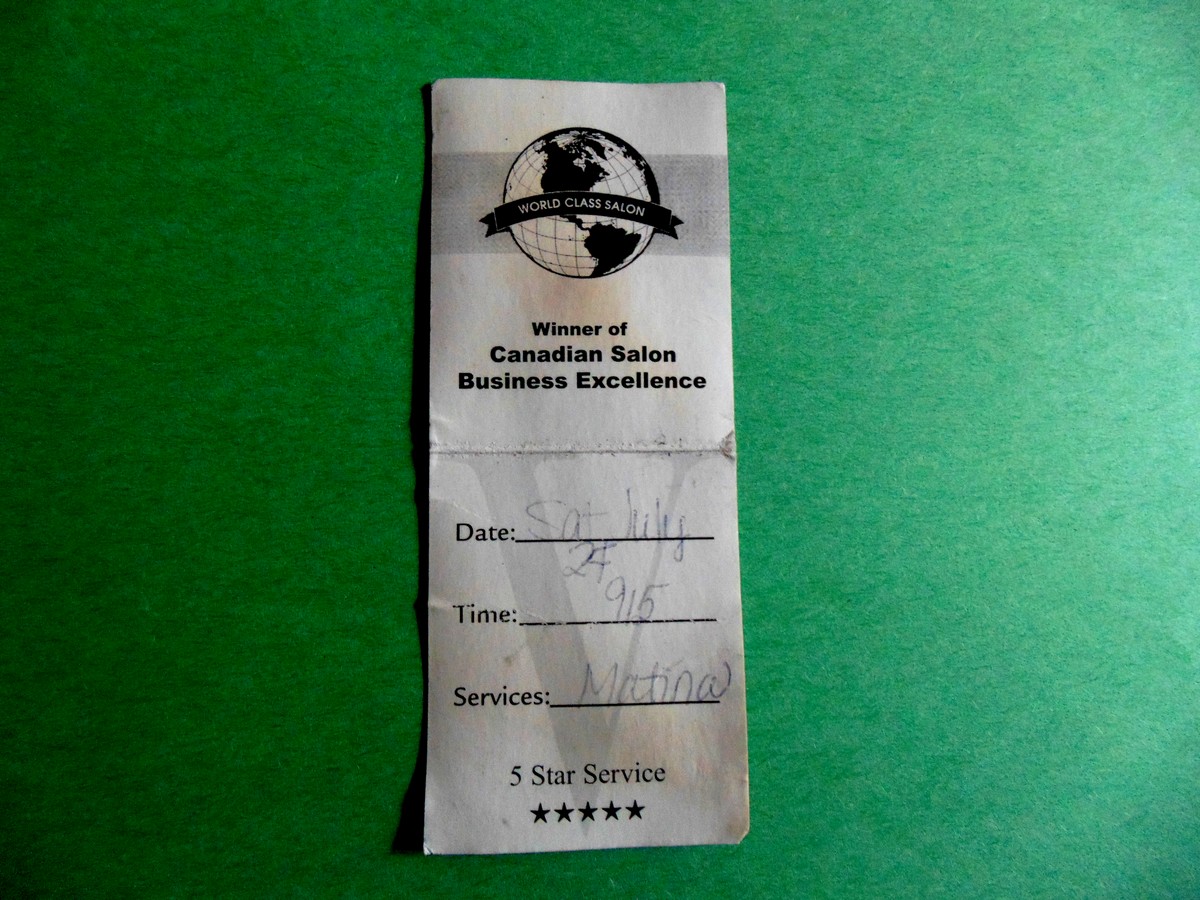
World class salon.

What exactly does that mean, anyway?

Winner of Canadian Salon Business Excellence, Five Star Service. What does that mean?

Kinda thinking it means not very much after this appointment with Matina. Oh, Matina, you’re a nice lady. You’re a skilled conversationalist, and obviously you’ve been working in public service a long time because you have conversation down to a fine art. The listening part of the whole exchange? Not so much.

This is what I say when I come in, pointing to my wild thatch: Trim the ends, not too much off. Reshape the bangs. Cut in some more long layers. You nod. Fine, no problem, you hear this all the time, no doubt. Matina is a pro, I feel confident of this as we talk. We go to the back, and I sink into the sink chair. Water temperature’s perfect, subtle jasmine shampoo scent soothes. You massage my scalp and I melt, almost drift off. Then it’s back to the chair, draped in plastic, and while you comb and snip and comb and snip and comb and snip, we talk.

Oh, do we talk. Movies, relationships, current affairs, travel, books, the economy, the price of groceries, reality TV (my favourite oxymoron), breeds of dogs. You move with acrobatic daring from one topic to the next, faster than I can, and I’m a seasoned talker myself. Before I know it you’re done cutting, and I have forgotten to watch what you’re doing. You’ve succeeded in distracting me. For a second I see your eye flicker from the ends of my hair to my eyes, and I look, too. It looks pretty short. But then it’s supposed to look shorter right after you get it cut, no?

I see, as you blow dry it, that it is not what I asked for at all. It’s the same cut I saw on the lady walking out of here when I came in; it’s the same cut on the other lady you were finishing up with as I flipped through a magazine. It’s the ubiquitous shoulder length bob, it’s the same haircut you gave them. I’ll bet it’s the same damn haircut you give everyone. No, it’s not what I asked for at all.

But I am nothing if not a pragmatist. Hair, once cut, cannot be uncut. I know this to be true. Letting it grow back in is all there is for it. I am a pragmatist and I am also a Canadian. I thank you for the cut. I tip you. And despite my disappointment, I will more than likely, in the fullness of time, make another appointment with you. Because I enjoy good conversation. And because this is a World Class Salon, after all.

Lori Hahnel  is the author of two novels, Love Minus Zero (Oberon, 2008) and After You’ve Gone (Thistledown, 2014), as well as a story collection, Nothing Sacred (Thistledown, 2009), which shortlisted for an Alberta Literary Award. Her work has been nominated for the Journey Prize three times and published in over thirty journals across North America and in the U.K.; her credits include CBC Radio, The Fiddlehead, Joyland and The Saturday Evening Post.  Lori teaches creative writing at Mount Royal University and the Alexandra Writers’ Centre.

She can be found at  www.lorihahnel.ca

♦♦♦

Up Next:

ruthig“… A Hansel-Gretel map
of seven words that won’t add up.”


shenfeld
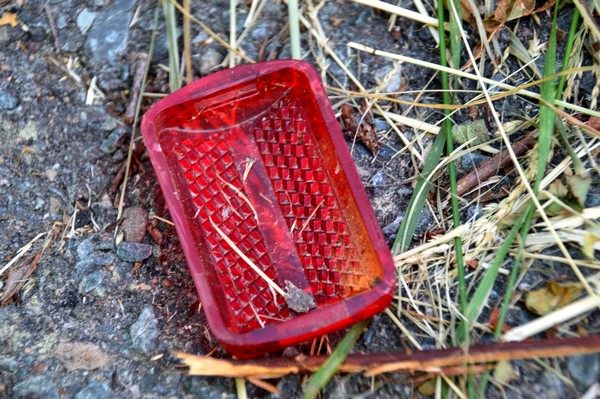
Good citizen, I sort the trash:
melon rinds, here;
The Sunday Times, vacant
Cheerio boxes, bottles, cans, there.

From Shakespeare’s Hamlet,
Stoppard lifted his confounded courtiers.
The Bard pillaged Saxo,
who…

Spin Procol Harum, you’ll sample Bach.

The mashup maestro counsels,
“Take, mutilate.”

“If I have stood…”

Go ahead—
Steal these words, layer the melody,
release the beat!

“Shoulders of Giants: The Dance Remix?”
Why the fuck not?

Tomorrow, I’ll wrap a potato in
a rocket’s fallen scraps.

Karen Shenfeld  is the Toronto Heliconian Club’s 2015 Writer in Residence. She has three books of poetry published by Guernica Editions: The Law of Return (which won the 2001 Canadian Jewish Book Award), The Fertile Crescentand My Father’s Hands Spoke in Yiddish. Her poetry has also been published in numerous national and international poetry journals. Along with being a poet, Karen is a widely published magazine journalist, editor, and filmmaker. Her indie documentary, Il Giardino, The Gardens of Little Italy, screened at several film festivals, including Planet in Focus. She is currently working on her fourth book of poetry, two documentary films, and a screenplay for a feature, which has been optioned by Canadian director Bruce McDonald.

♦♦♦

Up Next:

hahnel“Matina is a pro, I feel confident of this as we talk.”

yeoman

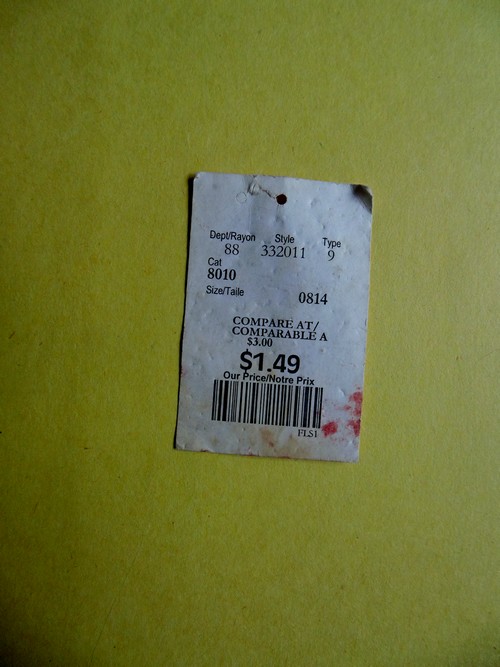
$1.49.
Compare at $3.00.
I wonder what it was.
What can you get for $1.49 these days?
A synthetic scarf or gloves from someplace like Walmart,
that before that came from someplace in Guandong
where vast aisles in even vaster factories
are filled with rows of women in pink smocks putting tags on similar items.
All that work and all that infrastructure and all that fuel to bring it here.

The same day I saw this piece of litter
I was reading about 18th century crimes that could get you transported
to Newfoundland or Australia.
So many thefts of small items of clothing: scarves, gloves, shawls.
It makes you realise
how terribly underclothed the poor were in those days,
how cold they must have been.

The same day I saw this piece of litter
I bought some shrimp at the fish shop on Duckworth Street.
“Is it from here?” I asked.
“It is, but it’s processed and packaged in China” he said.
“Packaged in China and sent all the way back to us?”
“Yes, it’s cheaper that way.”

Elizabeth Yeoman  is a Professor in the Faculty of Education at Memorial University of Newfoundland. Her scholarly work is about language, culture, history and memory. She has also published poetry and travel writing in literary magazines and presented radio documentaries on CBC Radio.

♦♦♦

Up Next:

 
shenfeld“From Shakespeare’s Hamlet,
Stoppard lifted his confounded courtiers.”

bennett

They cannot make sense of it all time and again,
so they create a manual to service their needs.

There is a system of sorts at play here,
that divides the information by group sequentially.

“The damn manual’s a crutch on which we can no longer rely!”
So they fashion radical theories, letting the manual grow stale.

There is a process of sorts in use here,
that groups the divided information periodically.

They cannot lie to others if they will not to themselves,
so they scapegoat the manual, then redact for an eternity.

There is a procedure of sorts at work here,
that informs the groups by division intuitively.

Finally, they cannot keep straight faces when asked to explain,
So they tell it like it is, citing the manual verbatim without knowing.

Jonathan Bennett is a novelist and poet. He is the author of six books, the most recent of which is The Colonial Hotel (ECW Press, 2014). He is a winner of the K.M. Hunter Artists’ Award in Literature. Born in Vancouver, raised in Sydney, Australia, Jonathan lives in the village of Keene, near Peterborough, Ontario.

More at: jonathanbennett.com

♦♦♦

Up Next:

“From above, it was easy to see how the waking world was criss-crossed with delicate bindings that strained to hold it together…”

govier

At first I assume this fell out of an armful of laundry. Is there a laundromat close by? And I’m thinking it was lost on the return trip from the wash, not the outgoing. Fresh.

Either that or the elastic gave out.

But no, it looks intact.

The garment looks very clean. The curb, and the pavement too, look clean, newish, swept. Are we being put on? Is this an art project masquerading as legit Litter? And what about that Ripper-ish shadow leaning over?

I’m becoming suspicious.

It looks a little staged, like a clue. Follow the red panties…

Red underwear is alluring. It spurs the imagination to what lies up that skirt, what lies inside. In old Edo, Japan, the women about town always showed a dash of red beneath their indigo kimono.

Young women wear red panties. I used to, didn’t I? Have a few pair over the years? I remember one. A Valentine purchase. I don’t wear them, anymore. I’m not sure at what age I gave them up. Maybe there was a moment, just as this looks to be a moment, an instant, an impulse, when I thought, the young woman thought, you know what? I’m done with all that.

Katherine Govier’s most recent novel The Ghost Brush is about the daughter of the famous Japanese printmaker, Hokusai, creator of The Great Wave. It has been published in the United States as The Printmaker’s Daughter, and will appear in translation in Spain, Quebec, and Japan.

Katherine’s novel Creation, about John James Audubon in Labrador, was a New York Times Notable Book of the Year in 2003.  She won Canada’s Marian Engel Award for a woman writer (1997) and the Toronto Book Award (1992). She has twice been shortlisted for the Trillium prize.

The author of twelve books, Katherine has been instrumental in establishing two innovative writing programs. In 1989, with teacher Trevor Owen, she helped found Writers in Electronic Residence. Today she is the founder and Director of The Shoe Project working to improve the written and spoken English of immigrant women.

She can be found at www.govier.com

**(‘red knickers’ photo by Allison Howard)

♦♦♦

Up Next:

bennett“They cannot lie to others if they will not to themselves”

pureed frog

Posted: August 24, 2015 in alice zorn
Tags: , , , ,

zorn

It had been over a year—a long year. Karl still missed Charlie. (Charlotte to the rest of the world, Charlie to him.) He’d been smitten the evening she winged a cherry pie at him. No shaving cream stunts for Charlie. Watch out when she got angry. A bona fide bakery pie. Thwack! Squish! Filling plopped onto his shoe, gunking up the laces. And cherry pie filling stained, did she know? Forget the shirt. Forget how much it cost and that was only the second time he’d worn it. When Charlie smacked him with a pie, that was when he knew she was the real thing. He sent her roses, waited a few days, and called her. Insisted she allow him to apologize. Promised he wouldn’t have a pie behind his back. She laughed.

They’d had good years together, him and Charlie. Comfortable, companionable years that made him understand why people got married and stayed married (which he hadn’t understood before). He shaved off his moustache as she requested. She decided on a single name for her dog as he requested. Wyatt never became his best friend, but what did Karl expect? Before he’d come along, no other man had challenged Wyatt’s doggie conviction that he rode shotgun in Charlie’s life. Even once Wyatt grew so old he was deaf to every other sound in the house, he still managed to struggle upright and bark whenever Karl came home. Intruder! Intruder! Intruder! Intruder!

Karl still mourned Charlie’s passing. He mourned remembering her. He mourned his solitude now. It was no joke being the one left behind. He went to bed alone. He woke up alone. Friends invited him over for summer barbecues where widows, who’d also been invited, gazed at him from lawn chairs with their jaws set to look defiant. Or desperate. Neither attracted him.

For a long time Karl kept shaving his upper lip. When he finally decided to let his moustache grow again, he was surprised it was grey. Well, of course, it was grey. Every other hair on his body was grey. Still. A surprise. He’d thought the moustache might resurrect his youth—help him catch a new Charlie.

Charlie had subscribed to a couple’s membership at the local gym and spa. She’d mostly taken advantage of the spa option. He used the weight room and the bikes, though never regularly enough to make a difference to his silhouette. He’d kept up the membership out of nostalgia. That fall he’d started going again because having a place to go gave a semblance of shape to his otherwise formless days. After his workout he often stopped in the juice bar for a cappuccino. He deliberately ignored the new trendy names for coffee—what in heck was a flat white?—and if the day ever came when he had to explain to one of the kids behind the counter what a cappuccino was, that would be reason enough to roll over in the morning, stay in bed forever, call it quits.

A month ago he noticed a woman with a perky haircut, probably his age, in the juice bar drinking a smoothie. The ends of her hair were wet. She winked at him over her straw. He blushed but nodded back. She opened a hand at the empty seat across from her.

Her name was Jeannette. She came to Aquafit classes Monday, Wednesday, and Friday. “Three days a week is fun. Five days would feel like work. I’m retired. These are my golden years, right?” She wore no wedding ring. He told her he was retired too. He didn’t say these were his golden years because he felt Charlie might have taken them with her.

Yet he began to look forward to Monday, Wednesday, and Friday. He imagined that if some essence of Charlie still existed in the universe, she would be pleased to know their life together had converted him to the ideal of coupledom. He would have liked to meet someone. Reclaim the happiness he’d had with her.

Monday, Wednesday, and Friday Karl always had a witty bon mot or a story to tell Jeannette. Her laugh was melodious. He liked to hear it. She was a good times gal. A bit on the hefty side. Not like Charlie. But truth be told, Charlie had been neurotic about her weight.

Jeannette mentioned that she loved to cook. Karl said he hadn’t had a home-cooked meal since who knew when. He stroked his moustache and tried to look hopeful. He said food was one of the great pleasures of life. He said he wished… He let the sentence trail off.

Two days later, on his way into the weight room, he stopped to look through the glass down onto the swimming pool and picked Jeannette’s turquoise bathing cap out of the dozen women bobbing in the water, wheeling their arms. After his workout and shower, he squirted himself with cologne.

“Hiya!” he greeted Jeannette.

She made dimples at him. Seventy-year-old dimples, but dimples nonetheless. Today she was sipping a thick green smoothie that made him think of pureed frog. “This is delish! Get yourself a straw, have a sip.”

He declined the offer of a sip but pulled out a chair. He was thinking of a roast beef and mashed potatoes meal with candles on the table. A good bottle of Merlot. Charlie used to do a sirloin tip to perfection.

“I’m glad I saw you today,” Jeannette said warmly.

This was it. It had to be. She was going to invite him over for a meal.

She dug her arm into the enormous woven bag slung on the back of her chair and pulled out a white 8 ½ x 11 envelope.

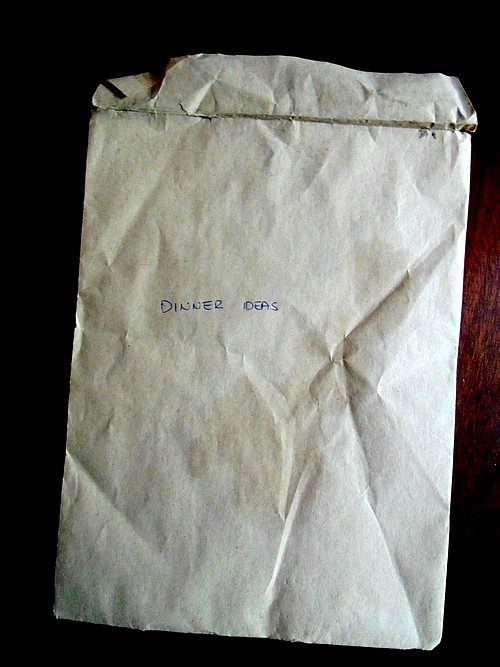
He was puzzled but took his cue from her wink. Whatever this was, it was good. Maybe, for her, a first invite to her house was a formal occasion. (He blinked at the sudden memory of candles melted to stubs and a flying cherry pie.) Maybe a woman who carried a purse the size of a briefcase gave out invitations the size of posters. He could feel several pages’ thickness inside the envelope, turned it over and saw how she’d written Dinner Ideas across the front. He still didn’t understand. Dinner, yeah, that was the right track, but what was this?

“These are really simple recipes. Spaghetti sauce, chicken strips, a couple of casseroles. You chop a few things, put them all in one pot, let it cook. Voilà! Once you’ve made them, let me know and I’ll give you some more.”

Was she joking? He peeked into the envelope. Even at that acute angle he could recognize the look of a recipe.

“Thanks,” his mouth said. Grimaced stiffly.

She seemed to think he was smiling because she smiled back. “No problem, my pleasure!”

He nodded, wondering how to cover his retreat, then knew it didn’t matter. He wasn’t going to sit with Jeannette while she drank pureed frog ever again. He stood with the envelope still in hand and stalked out of the juice bar.

At the first row of disposal bins he upended the envelope. Not into the paper bin. Into the unredeemable, unreclaimable, unrecyclable, garbage, crap, toxic substance, waste bin.

He left the building, strode to the parking lot. He wasn’t aware he still clenched the envelope in his fist until he tried to shove his hand in his pocket for his car keys. He mashed the envelope into a tight ball he dropped on the asphalt. Hoped he drove over it as he backed away.

Alice Zorn’s  book of short fiction, Ruins & Relics, was a finalist for the 2009 Quebec Writers’ Federation First Book Prize. She has twice placed first in the Prairie Fire Fiction Contest, as well as won the 2013 Manitoba Magazine Fiction Award. Her first novel, Arrhythmia, was published in 2013. She has a new novel, Five Roses, forthcoming in 2016. Originally from Hamilton, Ontario, she now lives in Montreal

She can be found at www.alicezorn.blogspot.ca
♦♦♦

Up Next:

govier“Are we being put on?”

clare

“She’s all arms and legs, that girl,” was what everybody kept saying to Myra when Teeny turned six and got gangly. Which irritated Teeny, who was not only pedantic but also sensitive to remarks about her appearance, and so she’d glare at whoever was speaking and she’d say, “That’s not even true. I have a body.” Slapping her bum to make the point, storming away, a tornado of limbs. Eventually Myra’s sister felt she had to have a word.

“That girl needs to learn to watch her tone.”

Her tone?”  repeated Myra. But Myra couldn’t do anything about it. She’d forgotten to be preventative. She never took her folic acid, and then at 33 weeks she’d been trapped alone in an elevator for ninety minutes, stuck between floors of the nursing home where she worked. She had to pee in her thermos, and she didn’t like confined spaces at the best of times, so when they got her out, she’d been hysterical, her blood pressure through the roof. Putting the baby in danger, so Teeny was delivered by emergency caesarean soon after. Spending her first five weeks in the NICU and couldn’t breathe on her own, and you could tell her apart from all the other preemies because of the purple birthmark on her cheek.

When Teeny was four months, Myra’s dog’s therapist raised the alarm. It was the last time they ever saw the therapist, as Myra had less time to remember to refill her dog’s prescription for canine Prozac after the baby, and it would not be long before she gave the dog away altogether. But this one last appointment was made ages ago, and if she hadn’t gone, they would have charged her. The dog bounding around the therapist’s office, lunging for chew toys, and the therapist said, “I think we’re seeing real progress here. But what about the baby?”

Myra confused, because other people had only ever admired her baby, her fortitude, the success with which she’d overcome adversity. They made specific remarks about the shape of her ears because they didn’t want to mention the birthmark.

But the therapist did. “A manifestation of trauma.” She showed Myra an article about 9/11 survivors who’d been pregnant and passed PTSD on to their children. “Low levels of the stress hormone, cortisol.” She told Myra, “It can mess with pigmentation. I don’t know. I’m just saying. I’ve seen similar things with guppies.”

When Teeny was five, she had the birthmark removed. She was being teased at school, and it was still really ugly, like a huge seeping wound had sat down on her face. Whenever Myra took her daughter’s photo, she’d tell her, “Turn the other cheek,” but she meant it the wrong way. When she wrote about the surgery on Facebook, her cousin Marsha compared the procedure to genital mutilation, but in the end Myra was happy they’d gone through with it. The scars were barely noticeable.

Kerry Clare is a National Magazine Award-nominated writer and editor of the essay anthology, The M Word: Conversations about Motherhood. She teaches The Art of Blogging at the University of Toronto School of Continuing Studies, edits the Canadian books website, 49th Shelf, and writes about books and reading at her blog, Pickle Me This. She is currently at work on a novel called Mitzi Bytes.

♦♦♦

Up Next:

zorn“Today she was sipping a thick green smoothie that made him think of pureed frog.”

bruneau1 - Copy

Before the diesel wheeze and asphalt
rumble, before a miasma of butts (battlefield: satellite view),

before a grizzle of frying meat and bagpipes’ blare from some
opened window, before the ash

bruneau2

of car parts meets crusher dust (summer eats winter),
before a gloveless thumb, a rotting orange, a greasy list
(hamburger, carrots), and before a sock requiring
a zillion Tide-washings to resume life
(question, common as Tim’s
cups: why just one?),
before such urban wreckage—

bruneau3 - Copy

(never mind a shady smell, cut grass and gas, small engines grazing Joni-style hissing lawns), on a path walled by rose-hung chain-link, this:

Like a hard candy sucked clear, Stop, it says,
Pick me up and I’ll save you, goes its evening-blue flare (daybreak pink
or sunset glow) best left for a signal-reader who knows
her stuff
—a blazing-trail commuter? a kid with training wheels?—
(red sky at night, yada yada, red sky in the morning) and takes
fair warning: whoa.

bruneau4 - Copy

Carol Bruneau is a novelist, essayist and reviewer who lives in Halifax. Her latest book is These Good Hands, based on the life of French sculptor Camille Claudel. She teaches writing at NSCAD University.

She can be found at www.carolbruneau.com

(photos by Carol Bruneau)
♦♦♦

Up Next:

clare“It was the last time they ever saw the therapist, as Myra had less time to remember to refill her dog’s prescription for canine Prozac after the baby, and it would not be long before she gave the dog away altogether.”