Posts Tagged ‘frontier college’

lanthier

High-rise hair-raise, letters of intent
Visions and revisions, cool A+ shoes
To-do wish list lipstick hit list
Eagle’s eye cam view, wheelchair whirls you
Write it with a Sharpie, write in sugarcane
far from LA TV, loose-tie surgery
Imaging success in crumpled paper clothes
Foot it neatly, plastics family!
Doodle bubble bugger phone, denim our uniform
Use every inch, in life and art
Chatty underwear says no secrets here
DWS could be Doing What’s Smart…
Makes nothing happen? Tell it to the teases.
Poetry’s here to pick up the pieces.


Kateri Lanthier’s  second collection of poetry is forthcoming from Signal Editions, Véhicule Press in Spring 2017. She won the 2013 Walrus Poetry Prize. She is the mother of [co-litter-contributors] Nicholas Sinclair (13), Julia Sinclair (9) and William Sinclair (7). Nicholas Sinclair enjoys being a member of his school’s robotics club, taking nature hikes and thinking philosophically. Julia Sinclair enjoys doing fractions in math class, running laps and drawing cats. William Sinclair enjoys dancing while wearing his fedora, writing poetry and playing the piano.


♦♦♦

Up Next:

musgrave1“We always lie…”


gaughan

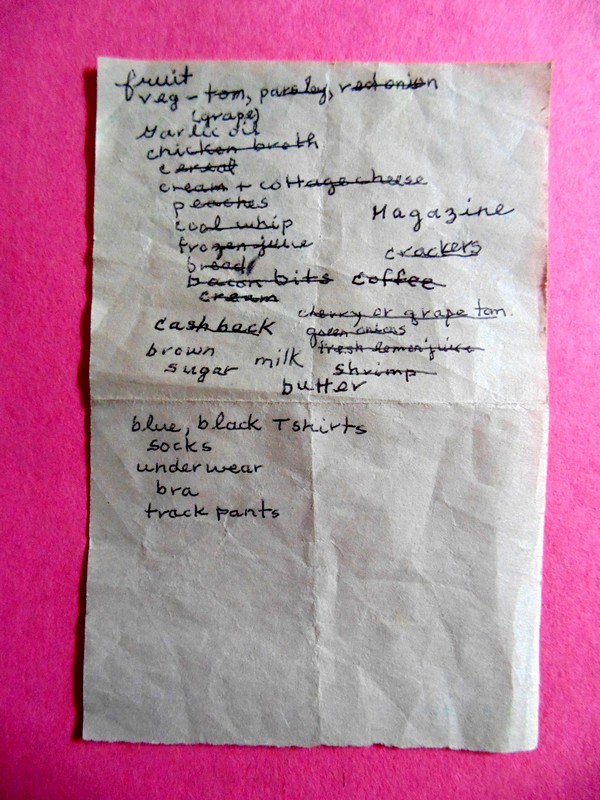
In her heyday hosting a get-together wouldn’t have fazed Loretta, but trotting from store to store under a harsh sun, panting, unsure what was already in her bag and what was still to be purchased, she realized that the hey!  had left her day years ago. No longer could she whip everything into shape—not her kids, who were grown and running loose in a cracked-up world; not her home, once pristine and party-ready; not even herself, although her hair was newly permed into ridges already softening with sweat, releasing a floral perfume with chemical top notes. It went without saying that Harold was in worse shape, sprawled on the Chesterfield watching televised sports like he’d taken a vow to see his teams through thick and thin, season after season, till death do them part. In the last few months his state of hygiene had sunk to a level beyond spousal rescue. And the people gathering tomorrow weren’t any folks you could make pleasant conversation with, but her own family returning to the homestead. Every lapse would mean something to them. If she burned the beans or offered a drink in a cloudy glass, glances would be exchanged. Harold’s stink would certainly be noticed. And the yard gone to ruin, a waist-high unmowable meadow. She’d swung the rusty scythe a few times around the back door, creating a rough patch for chairs, but left the rest wild. She planned to say it was better for the environment that way. Your father and I are against lawns. We’re into preserving habitat for wildlife now. The kids probably wouldn’t buy it. They were primed for decline.

“Don’t go to any trouble, Mom” her eldest daughter had said on the telephone. “We’re bringing all the food.”

Well, Loretta wasn’t falling for that nonsense. When family came, you fed them. No matter how fractious they were. And so there would be salads and fruit, lots of roughage, because the grandkids had refused to eat her roast last year. Nothing with a face, they’d explained, smirking. She was serving shrimp this time. She’d never seen a face on a shrimp. And the green salad would be sprinkled with bacon bits, fake meat anyone could eat. Plus cherry tomatoes, peppers, onions—no, someone had an allergy. Was it a son-in-law? Anyway, she’d leave onions out—cottage cheese sprinkled with dill, plenty of crackers, and a rainbow Jell-O mold to add cheer to the table. For dessert, peach cobbler with Cool Whip. They wouldn’t dare find fault with that.

She was nearly ready. She just had to nip into Eaton’s for a few items. Scurrying toward the entrance, she patted herself down looking for the list but couldn’t find it. No matter. In the cool brightness of the store, she could remember perfectly. T-shirts and underwear for Harold in practical navy or black to hide stains, and track pants, extra-large. For herself, a new bra. In a jiffy she’d find the one she liked among the rows of sturdy boxes standing at attention in the lingerie department—cross-your-heart support to brace a woman for the challenges ahead.

What a relief that some things didn’t change.


Laura Rock’s  fiction has appeared in Canadian, U.S., U.K. and Irish publications, including The Antigonish Review, Pear Drop and Southword and is forthcoming in The New Quarterly. Anthologies include the Seán Ó Faoláin Short Story Prize (Munster Literature Centre, 2013) and How to Expect What You’re Not Expecting (TouchWood Editions, 2013). She lives in Lakefield, Ontario.

Follow her on Twitter @laurairock


♦♦♦

Up Next:

lanthier“Doodle bubble bugger phone, denim our uniform”


memory

Posted: December 10, 2015 in alice major
Tags: , , , ,

major

What appointments am I missing?
What year is it?
—What mission
am I setting out on
along this hallway/ highway/
—sky way?
Surely it is spring beyond
this corridor? Hope?
—Green. Leaf. Gap.
Holes
punched along the edges.
So much torn away.

Alice Major’s  tenth collection, Standard candles, is now available from the University of Alberta Press.
♦♦♦

Up Next:

gaughan“In the last few months his state of hygiene had sunk to a level beyond spousal rescue.”

hicks


Simple.
First, the pines monolithic in white sand moonlight
then the slushie blue and cherry red flashing behind
Paul’s old truck.
Sent us on our way when he sobered up
thrust into the great big maw of the prairie sky.
One more Bob Dylan song and I’ll scream. He smells so sour I wish
they hosed him down in the tank. Body wash. A luxury.
All the fragrant people forgetting they have dirty arseholes
Just like Kerouac said. Just like Kerouac said.

That sky went from one side of you to the other,
terrifying the god into people, that sky.
And then the mountains, the raised hackles of earth.
With your heart in your mouth, you forget you’re hungry,
you have other, metallic tastes.
A highway where women disappear like they’ve been
swept away. A straw broom for the poor people, the
same thing them stupid first pigs made their houses out of.

Down through clouds at sunrise,
2 hours on the ferry and made 14 dollars playing Jesus songs
for bread and cheese. Can’t get cold cuts, they go bad too fast
sleeping in the spruce bush. If it don’t keep,
you’re throwing up with no healthcare
At some point we rent a motel room by the week. Cereal and milk
on a good day.   Tourists are on their way out, it’s September.
Steven has AIDS and he says there’s a church where you get
apple juice in boxes but they stamp your hand so you only get one.
We pretend the ketchup packets
from McDonalds where we go to pee
are spaghetti sauce. Someone takes money from Steve and
he is about to bite them, yelling I have AIDS mother fucker

This is around when I leave, and you throw yourself in the ocean
because you are human litter.
Tried to clean up the best you could but there’s
crap everywhere still
and I’m still hungry most of the time

Dawna Matrix  wears many hats, including insurance broker, poet, mother, chauffeur, and occasionally just a chapeau made of fire.  She lives in Oshawa with her husband, daughters, and a grumpy cat.


♦♦♦

Up Next:

majorWhat year is it?


abdou

Guaranteed unless
wrapper damaged or open
Medicare Bandage

Is that real litter?
Think about picking it up.
Put it in the trash.

Some child skinned a knee
a bike or skateboard wavered
But why hurt others?

One dirty bandage
will not fix the injury
of sad Mother Earth.

Angie Abdou is a novelist with four books to her credit. The most recent is Between (Arsenal 2014). She teaches Creative Writing at Athabasca University.

Note: ‘The Band-Aid Haikus’ were written by Angie’s children, Ollie (8) and Katie (6)

(This was so interesting to do with little kids. They were genuinely perplexed —“Is that real litter! Why would someone do that?” They came up with the lines—other than the first, which came from the package—and we worked together to count out the syllables and make them fit. ~ Angie Abdou)

♦♦♦

Up Next:

hicks“One more Bob Dylan song and I’ll scream.”


peonies


Do you already regret the wedding?

Are you into conceptual art?

Or did you hope that someone would come to brush the petals with her fingertip

and know that they were real?

Rona Maynard is the author of a memoir, My Mother’s Daughter, the leader of a one-day memoir workshop and a speaker known for mental health advocacy. Many readers remember her as former Editor of Chatelaine.

(Photo by Rona Maynard)

♦♦♦


Up Next:

abdou“a bike or skateboard wavered”

rudolph


Flashlight, doesn’t work. Pencil sharpener, doesn’t work. Salad dressing jar with stirring device, doesn’t work. Too inexpensive to warrant returning. Gas, time, et cetera. Garbage. Garbage can, doesn’t work. I step on the lid-opening pedal, and the lid doesn’t open. It sticks. I bang on the lid, then kick it. It rolls across the kitchen, makes a dent in the drywall. It still doesn’t work. I throw all of the above, including garbage can, in a box and put it on the curb.

You’d pay me less, but then you’d go to jail. So you pay me the least possible, according to the law. New opportunities for profitable investment, this is what you are waiting for. While you wait, you suffocate in goods you cannot sell. I suffocate in goods that don’t work. I have stopped making goods and am now making administration and service. They, over there somewhere, are making strange little items out of shiny, colorful plastic with multiple moving pieces that will, upon arrival, not work.

Sunglasses, don’t work either. One lens is darker than the other, causing dizziness and inability to see what’s out there. What is out there? Me, you, they, a planet, but: is it working?

Your cookie, post-meal at the upscale Chinese restaurant in the cosmopolis, tells you that great fortune comes to those who take advantage of the combination of substantial dislocations and greater ability to produce at scale. Lucky you!


Katja Rudolph’s  novel Little Bastards in Springtime  was nominated for the 2015 Evergreen Award. It’s about a refugee fleeing war. Though it takes place in the mid-90s, it’s tragically topical. Katja lives in Toronto with her people and is at work on her third book. Her second, The Year, is epic in length and scope and is being edited. Do you like a long read? Katja does.

She can be found at www.katjarudolph.com and @katjarudolph

♦♦♦


Up Next:

peonies“Do you already regret the wedding?”


harris

—on a southern train
—on a midnight train
—(over and over again)
—on a jet plane

done
making tracks
making a break for it
on the lam
calling it a day
blowing the joint

heading for the hills
pulling up stakes
hanging up the fiddle
throwing in the towel
hoisting the blue peter
lighting out for the country

beating a retreat
hitting the road
striking a blow for freedom

getting lost
shoving off
taking off toddling off trotting off
taking a powder
taking wing
taking to my heels

decamping

hightailing it
weighing anchor
skedaddling
splitting

—off to the wild blue yonder


Toronto poet and essayist Maureen Scott Harris  has published three poetry collections. Drowning Lessons (Pedlar Press, 2004) was awarded the 2005 Trillium Book Award for Poetry; Slow Curve Out (Pedlar Press, 2012), was shortlisted for the League of Canadian Poets’ Pat Lowther Award. Harris’s essays have won the Prairie Fire Creative Nonfiction Prize, and the WildCare Tasmania Nature Writing Prize, which included a residency at Lake St. Clair, Tasmania. In 2012-2013 she was Artist-in-Residence at the Koffler Scientific Reserve at Jokers Hill, north of Toronto. Since 2012 she has worked with Helen Mills of Lost Rivers Toronto, designing poetry walks that follow the city’s (sometimes buried) rivers and streams. Waters Remembered, a chapbook, will be published by paperplates in Spring 2016.
 

♦♦♦

Up Next:

rudolph“You’d pay me less, but then you’d go to jail.”


andrews

First thing I notice: my litter doesn’t look like litter, although it was indeed (I’ve been assured) found littering the street.

Second thing I notice: my litter has no URL. Where has it been for more than two decades?

Research tells me Waddingtons is a publisher of cards and board games.

Research also tells me that in 1941 the British Secret Service had Waddingtons create a special edition of Monopoly for World War II prisoners of war held by the Germans. Hidden inside these games, distributed by the International Red Cross, were maps, compasses, real money and other objects useful for escaping.

At this point I move far, far away from making the actual litter bit the feature of this post; it’s merely the kick in the pants that leads to more research and analysis (specifically, inner musings, as in WTF) which leads to a winding trail through the worm hole of WTF causes people to litter?  I’m not just angry when I pick it up on the road, in the bush or, worse, in our lake… I’m WTF furious.

I journey down this winding trail and around and around and ride the WTF  roller coaster trying to ferret out a ‘source’ for littering, but cannot detach my thinking from the link between litter and the larger problem of pollution. Finally, I twist the few thousand words bouncing around my brain into this representational visual—the result of a protracted cause and effect analysis.

andrews1

It’s simple and dark by deliberate choice, because there is no answer, only the dreaded question.

I did not misspell cede … I chose it for all that it means beyond seed  [Yield. Concede. Surrender. Relinquish. Abandon. Give Away.]

Bottom line: there’s a devastating legacy inherent in every piece of litter.

Cheryl Andrews  is a visual artist and photographer, depicting her view of the world through words and imagery. She lives in Seguin, Ontario, where she pursues these crazy-makers full time.

♦♦♦


Up Next:

harris“done”


coulter

what if your job was as a collector of debris along a stretch of highway between two towns? where would you start, where would you finish?

what if you spent your days driving between the two towns, half on the shoulder, half off the road, a yellow arrow sign flashing atop your truck cab.

what would you find?

you would find tire remnants, partnerless shoes, soiled diapers, broken chairs, stained mattresses, road kill – dead skunks or cats or deer or rabbits – piles of excrement, some human.

you would find gloves and bras and shattered televisions and cassette tapes and gigantic plastic coke bottles.

you would stub your toe on a heavy chunk of air brake and be thankful for your steel-toed boots.

then, on that final day, you would find a price tag, a small white piece of cardboard stuck to a used tissue. or is that a fabric softener sheet?

it’s an innocuous item, a minor throwaway, not worth a second thought.

but you would be frozen, paralyzed.

after all the crap you’ve picked up, after all the tossed cigars and cigarette butts (why do smokers consider the world their ashtray?), after the used tampons, beer cans, and half-eaten mouldy hamburgers, this is it, this is the one that will make you walk away, turn in your garbage poker, and hand over the keys to your truck.

you will find a job slinging coffee, or babysitting the neighbour’s kids, or mowing lawns, knowing that, whatever you do, you will be forever plagued by a question.

what costs $5.48?

Myrl Coulter  is an Edmonton-based writer of fiction and nonfiction. She is the author of two published books, most recently A Year of Days (UAP, 2015). Her first, The House With the Broken Two: A Birthmother Remembers (Anvil Press, 2011), won the 2010 First Book Competition sponsored by the Writers Studio (Simon Fraser University) and the 2011 Canadian Authors Association Exporting Alberta award. Her work has been published in Geist, Avenue Magazine, and several anthologies. She is cautiously optimistic that her third book will make its published appearance in 2017.

♦♦♦

Up Next:

andrews“I did not misspell cede … ”