Posts Tagged ‘frontier college’

dillon
Wee small fairies
hungry and
loose
in the street

jettison the cup and straw

wee left you in a mailbox taking cover
afterthoughts
perched
on
our signatures


Jude Dillon  has won several awards as a news photographer. His poetry is published in magazines online and in print throughout Canada, the United States and Europe. Solitary walks with his camera, playing guitar and reading are distractions that inspire. He lives in Calgary, Alberta.

He can be found at: www.judedillon.com

**photo by Jude Dillon

♦♦♦

Up Next:


walker“your obligatory lip was laced with poison”

leedahl

(Car Scene: male is driving, female in passenger seat)


Him: Why do you always have to do that?

Her: What are you talking about?

Him: You, that man, asking for directions. I could have just punched the address into my phone and let the GPS figure it out, but no, you just have to talk to people. Talk, talk, talk, all the time. What’s wrong with you? You can’t stand in a grocery line-up or sit in a coffee shop without opening your trap, can you?

Her: (Looking into her lap at the note she’d hastily scribbled.) I – I just thought, well, he was right there, and he was cutting the grass so obviously he lives here and knows the area. (pause) And why is it wrong to want to make human connections? Why do you get furious every time I talk to someone? (Looks at him, sees he is red-faced, fuming.) And I like to write things down. I need to write some things down. When someone gives me directions it’s like hearing algebraic equations or Sudanese … I can’t remember them, can’t process them. I need to see them.

Him: You’re crazy, you know that? I am in a car with a crazy woman.

(They approach a traffic light.)

Her: The light’s yellow.

Him: So now you’re telling me how to drive, too!

(He speeds up, then violently slams on the brakes for the red light. She almost hits her head on the windshield. She seems in shock for a moment, then she surreptitiously turns the note over, writes on the back of it. She opens the car door, sticks one leg out, throws the note at him.

Her: (Looking right into his eyes) Sometimes I need to write things down.

Him: What the ….? (Looks at the wrinkled note on the seat beside him. Camera closes in on the scribbled words: Fuck you!)


Shelley A. Leedahl  is a multi-genre writer in Ladysmith, BC. She frequently presents across Canada and also works as an editor, writing instructor, and freelancer. Her most recent books are I Wasn’t Always Like This (essays, Signature Editions, 2014); Listen, Honey (stories, DC Books, 2012); and Wretched Beast (poetry, BuschekBooks, 2011). An illustrated children’s book is forthcoming with Red Deer Press. See www.writersunion.ca/member/shelleya-leedahl


♦♦♦

Up Next:

dillon“hungry and loose in the streets”

19

Posted: February 1, 2016 in jeff bursey
Tags: , , , ,

bursey

Everything went smoothly. She had become deft. Wallets crammed with bills and plastic, cell phones, keys, passports. The occasional surprise: gum (yuck), a frozen finger once (she pretended it was a toe to get free drinks, but there was something creepy about it). Once, a bunch of twigs. A living, especially passports and cell phones that could be repurposed (her word), tracked and hacked, bank accounts emptied, everything gone. She would have been gone an hour, or a day, before the vacuuming started. The girlish part of her not yet deadened by the daily filching collected souvenirs. Two rabbit’s paws (you can’t have enough luck), a colourful scrunchie, pocketbooks (she read some of them), a silk scarf. Occasionally a cryptic note reminded her of a location. Like the one with the washed-out lines, torn from a legal pad maybe, dated on top. Dated wrong (like, the 23th?). She knew it had been consulted, its knowledge consolidated (she liked C-notes and C-words), in the elements. A rough-shaven man with nervous eyes, intent on a door. Never saw her coming or going, as always now. She was that good, she never wanted attention, not in that situation. Walking away easily, turning a corner smiling, then hearing the gunshot. She didn’t run, but scampered (she did not like what that word implied) in a normal way, and was out of sight before the cop cars arrived. She saw his face in the paper the next day and smiled.

***

Cross out the days on a calendar, slowly, his lawyer advised, you only have so many free ones left. The plan had gone wrong, unsurprisingly. The robbery and kidnapping had been timed for a snowy April, Mondays or Thursdays, four dates only. He’d noted the times Mr. Money left his home, at dawn with week’s newness, at dusk near its working end, then he lost that piece of paper, not that it would have saved him. He hadn’t forgotten the mask, the gun, the note, the stolen car worked, but it went wrong without the paper. That damn piece of paper, his talisman, folded like an accordion. He’d stared at it over and over, and could still see it. To tell them who provided the gun would mean a jailhouse death sentence. He was in this alone, again. That day there was no one around either. Oh, no, a short girl in her twenties, or something. Plain. Then the door opened and he reached to check the paper again, maybe just to feel it. Not there, and not his wallet either. But Mr. Money adjusted his scarf, stepped forward, it might be the last chance, so he nervously moved too, and the gun suddenly went off. Down went Money. He stood there until the police roared up. Whatever went badly in his life had an unimpeded path despite his efforts to be organized. He’d lost the paper, and was on a smooth path to ruination.


Jeff Bursey is the author of Verbatim: A Novel (Enfield & Wizenty, 2010) and Mirrors on which dust has fallen (Verbivoracious Press, 2015). He is also a short-story writer, playwright, and literary critic. He lives on Prince Edward Island.


♦♦♦

Up Next:

leedahl“And why is it wrong to want to make human connections?”

anderson-darg

Once, shrink-wrapped and shiny,
I knew only possibilities:
the uncapped pen waiting
to meet me, the anticipation of potent
ideas tattooed into my skin.

But then I was wrenched
from my own corseted
longing into the world’s
classroom, passed from sweaty
hand to sweaty hand, and still, even
unused, untapped, I became
wrinkled, nothing
more than forgotten
potential in a rucksack.

Now, discarded, I wait on this littered ground,
surrounded by misgivings and desires, still waiting
in hope that someone will pick me
up, smooth my tired creases, hold me
lovingly, and begin


Gail Anderson-Dargatz, whose fictional style has been coined “Pacific Northwest Gothic” by the Boston Globe, has been published worldwide in English and in many other languages.  A Recipe for Bees and The Cure for Death by Lightning were international bestsellers and were both finalists for the Giller Prize. The Cure for Death by Lightning won the UK’s Betty Trask Prize among other awards. Both Turtle Valley and A Rhinestone Button were national bestsellers in Canada and her first book, The Miss Hereford Stories, was short-listed for the Leacock Award for humour. Her new novel The Spawning Grounds will be published by Knopf Canada in September 2016.

Gail also writes novellas for adult literacy learners through Orca’s Rapid Reads program, and mentors writers around the world through her private on-line forums. She lives in the Thompson-Shuswap region of British Columbia.

For more on working with Gail, please visit her website: http://www.gailanderson-dargatz.ca/cms/


♦♦♦

Up Next:

bursey“The robbery and kidnapping had been timed for a snowy April…”

tinsel

Posted: January 26, 2016 in allyson latta
Tags: , , , ,

latta (hers)

I still remember the afternoon she showed up at our door with a grocery bag stuffed with colourful tinsel. It wasn’t Christmastime, though. It was August, the lazy, hazy middle of summer holidays.

Cary had moved into a house at the other end of our street, and she’d do that – come by every once in a while with a grubby plastic bag in hand, a surprise inside to share. Sometimes a bunch of chocolate bars. Where did she get them all? (Mom worried about that.) Sometimes playing cards. Or a game, like Clue.

The tinsel was the best. Or maybe the chocolate bars.

I don’t remember how I met her. She kind of found me. Sometimes I’d say I was busy because I wanted to play with John or Tim. I couldn’t spend too much time with girls. But if I had nothing better to do, we’d hang out – in the yard, in the back alley, or climbing on the roof of Krista’s shed, a few doors down. (Mom worried about that too.)

We never played in Cary’s yard.

She was my age – eight – and had long stringy brown hair, like she never brushed it, and her clothes were kind of dirty. She liked to do fun stuff, but she never said much. At first that seemed weird, but I got used to it. She didn’t smile much either, even when I knew she was having fun.

Once she got me to go with her to a bank machine a few streets way. She’d taken the bank card from her grandmother’s purse and knew the PIN. That was scary but exciting too. Did the police arrest kids? Could Mom and Dad get me out?

When I finally confessed to Mom – I couldn’t keep it in, and it hadn’t been my idea, after all – she frowned and said I was not to encourage “that behaviour.” I was never to go with Cary to the bank machine again.

“You understand that’s stealing, right?” she said. “Even if it is her grandmother.”

She was thinking of telling, but I begged her not to. Things never go well when moms tell.

My mom and dad exchanged looks when I talked about Cary. Mom thought there might be something wrong – a “delay,” whatever that meant. She’d heard from a friend on the street that Cary was living with her grandparents, who kept to themselves, though neighbours on either side sometimes heard angry yelling from that house.

“Maybe I should –” Mom said more than once.

“Don’t get involved,” Dad would say.

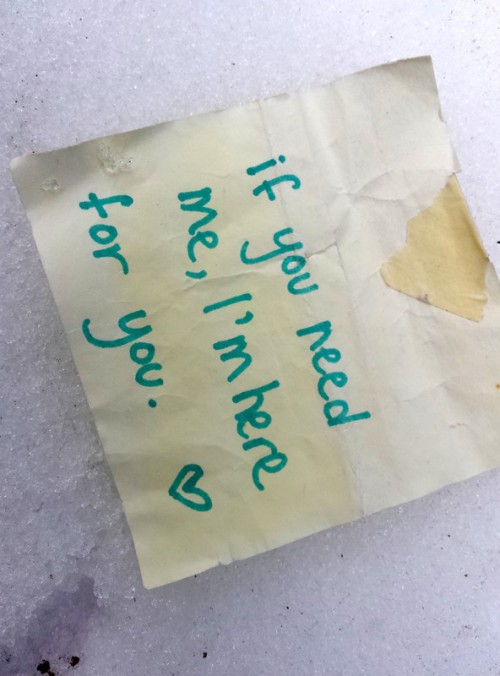
Once Cary gave me a sticky-note with a message in green marker – If you need me, I’m here for you – and she’d drawn a silly little heart. I felt my face turn red, stuffed the note in my pocket but didn’t say anything. She never expected replies. Or anything, really.

Later I crumpled and dropped the note outside somewhere – you know, accidentally-on-purpose.

That August afternoon of the tinsel, Cary and I ran around our humid backyard like maniacs, hurling handfuls of sparkly strands – silver, red, green and gold – at tree branches and bushes, on the bleeding-heart plant and the fence, wherever it would stick. That was fun. Mom smiled and said it was beautiful, Christmas in August, though later, when she gave us chocolate chip cookies and milk on the deck, she looked sad. I think she wanted to comb Cary’s hair.

We wiped our sweaty faces with our arms and munched and drank while admiring the glitter fluttering and catching the sunlight, so sharp it made our eyes water. I remember that – her eyes watering. We didn’t talk. I don’t think we talked. And then we went to Krista’s to climb on the shed.

In the weeks and months that followed, most of that tinsel blew away in the wind or got washed off by rain, and some of it Dad yanked off, grumbling that he didn’t know what had possessed us, and he’d be cleaning it up till the cows came home.

Bits hung on stubbornly and were still there, worse for wear, when all the leaves had fallen and Christmas finally came. Tired tinsel dangled limply from bare branches or peeked through the snow in the shrivelled flowerbeds. And some of it was there even after the snow melted again and long after the mean grandmother died (so we heard) and Cary disappeared from the neighbourhood. She never said goodbye.

These many years later, I still think about tinsel glinting in summer sun, about the little note with the heart and whether she ever found someone who needed her, and about all the questions that I didn’t ask. That no one asked.


A writer, literary editor, and instructor, Allyson Latta has edited acclaimed fiction and creative nonfiction by Canadian and Caribbean writers, including winners of the Commonwealth Writers’ Prize, Scotiabank Giller Prize, and Rogers Writers’ Trust Fiction Prize. Trained in journalism, she held positions with newspapers and magazines before turning to book editing. She’s a creative writing instructor and online mentor at University of Toronto SCS (Memories into Story I and II) and for more than ten years has led workshops for libraries and writers’ organizations in Canada and abroad. Since 2010 she has also run a dozen week-long instructional writers’ retreats, in Canada, the U.S., Central America, and the Caribbean. Many of her students and editing clients have gone on to be published in various forms. Allyson’s website, Memories into Story, features essays, interviews, and resources to inspire writers.


*if you need me…* photo, by Allyson Latta


Up Next:

anderson-darg“passed from sweaty hand to sweaty hand, and still, even unused, untapped, I became wrinkled”


DSC04418

Blue flame?
stained like the Aegean Sea in sunlight
colour of my high school boyfriend’s ‘69 Chevy 2
a rust heap jangling to Saskatoon
joyriding in his Grandma’s car
Blue chunk of glass?
we’ve been to the Dog ‘N Suds
blueberry milkshake
suck down half
fling the rest out the window
Cartwheeling closer
Blue kite?
wind slams against the car
One revolution round the park
jouncing into a farmer’s field
tall smeared paper container
blue milkshake
splashing its voiceless protest
down the length of the back car door.

Today, sailing out of my trashy past
Wonder Wafers, World’s Most Perfect—
It affixes to a light post
Flutters onto a park bench
Air Freshener Clean Car…
1975
our guilty hands sent milkshake containers
into summer’s slide
dumped ashtrays in parking lots
an empty box of Kotex pell-melling down the school yard hill
we were seventeen—

This rectangled message sailing, litter-blue
Shouting cleanliness
Launches itself into August’s draught
A splash of blue riding wind and light
Air Fresh—
a bit of flashy trash
out for a joy ride.


Rosemary Nixon is a fiction writer and free-lance editor. Her first collection, Mostly Country, (a Nunatak Fiction imprint, NeWest Press), was shortlisted for the Howard O’Hagan Award. Her second collection, The Cock’s Egg (NeWest Press) won the Howard O’Hagan. Her novel, Kalila (Goose Lane) was longlisted for the ReLit and shortlisted for the George Bugnet Award. Her most recent, Are You Ready To Be Lucky? (Freehand Books, 2013) was nominated for the Frank O’Connor International Short Story Award. Rosemary lives in Calgary.

She can be found at www.rosemarynixon.com

♦♦♦

Up Next:

latta (hers)“She liked to do fun stuff, but she never said much. At first that seemed weird, but I got used to it.”


wilson

She fiddles with her chopsticks. “I once had these green socks.”

He pushes his fork through his chow mein, looking for the shrimp and chicken.

Her chopsticks tumble again from her fingers. She aligns them neatly on the table and picks up the paper wrapper they came in. Twirling the wrapper around her finger, she sees this irritates him. She lets the wrapper unfurl and pushes it to the edge of the table where the passing waiter picks it up and replaces it with a fork. She smiles for the first time since they arrived. A little joke, and to give her options.

She continues. “The point is, I’ve been wanting to talk to you about how — and I get how this sounds —“ His tie falls off his shoulder and onto his plate.

“Christ! Would you believe?!” He’s not asking her. He pulls a stack of paper napkins from the overstuffed dispenser.

“I remember at the time how odd it was that I had to have these socks because I was pretty young and your parents buy you socks, right? I was so nervous to tell you how much they cost. I must have told you they were meant as a gift. But they were for me.”

He looks up from wiping his tie. The question is forming, she can see it, what has he ever done that she cares so much about what he thinks? He takes a fresh napkin and daubs it in his untouched water, one of the ice cubes spilling over the lip of the glass. He recoils and cradles his hand. She instinctively passes him her napkin and begins to rush.

“Anyhow, these socks got a hole in them and for years I kept them in the back of a drawer and then in my bag, just so I could look at them.”

She’s starting to flood. Funny how it feels like clarity, like all the bullshit is slipping away and here comes the truth. She leans closer, her voice steadily resembling his so closely that he has no choice but to meet the gaze of this stranger. Have they met before? His eyes have gotten milkier since she saw him last. But here she is, always the one to invite him to lunch. Maybe this time she’ll say the right thing.

“Mom threw out my blanket when I was young. Moms do that, it’s OK. But I threw out these socks and, I have to tell you, it’s a part of growing up I really wish I could undo, because then maybe I could keep looking to them for answers and not you.”

His face softens, no, melts. Is he finally readying himself to speak? It feels like one of those miniature springs from the tip of a ballpoint pen. You looked forward to the pen drying out just so you can disassemble it and *boing*. She feels, what is this? A flirty vibration. Intimate, lurching from her stomach to her throat, and as he smoothes his tie to his chest she’s not done talking. She’s not done talking. She’s not done talking. She’s not done. She’s not done. She’s not done. She’s not done. Oh, no. Oh, no. Oh, no. Don’t tell stories. Don’t tell stories. Don’t tell stories. She cups her hands over her mouth and leaves.

The waiter prepares the cheque, folds it sharply down the middle and pitches it like a tent on the table. Bumming a cigarette from the cook, he goes out back, retrieves the rumpled chopstick wrapper from his apron pocket and strikes a match.


Julie Wilson is the author of Seen Reading. Originally from Toronto, she lives in San Diego.


♦♦♦

Up Next:

DSC04418“a rust heap jangling to Saskatoon”


stars

Posted: January 14, 2016 in amber dawn
Tags: , , , ,

dawn
ascendant natal chart comet lovejoy is very active fixed stars four quadrants in three
houses full moon in virgo feel the cosmic tug-of-war hellenistic wisdom (or burden)
high tides however this personal dilemma will motivate you you lucky you your element
is wood a circular clearing in the forest a full moon on Sunday lunar perigee this method
of divination eternal negative sunsign pluto uranus square squaring triangulate third
dimensional portal season the past has lost its power pleasure seek pleasure saturn in
sagittarius saturn in retrograde saturn in your bedroom on Sunday sidereal astrology
solar eclipse can blind you look directly see seers sooth say what? vernal equniox the end
of another winter crone passes maiden a red silk ribbon sex puts a halter on the beast

f*cking one more supermoon
and we’ll all careen
into damn darkness


Amber Dawn  is a writer living on unceded Indigenous land belonging to the Coast Salish peoples (incorporated Vancouver, Canada). Her memoir How Poetry Saved My Life: A Hustler’s Memoir  won the 2013 Vancouver Book Award. She is the author of the Lambda Award-winning novel Sub Rosa, and editor of the anthologies Fist of the Spider Women: Fear and Queer Desire and With A Rough Tongue. Her newest book, a collection of queer glosa poems, Where the Words End and My Body Begins, came out in April 2015.

Find her at http://www.amberdawnwrites.com

** ‘stars’ photo by Amber Dawn

♦♦♦

Up Next:

wilson“His eyes have gotten milkier since she saw him last.”


winter

I’m livid at Lost Cockatiel
Telfea’s poster pink
If I admitted what I feel
you’d send me to a shrink

We’re on our way to Harris Court
me and my skeleton key
to sneak up while Telfea’s out
and set sweet Sugar free

Pet shops, zoos and carnivals,
cages and enclosures,
amphibian emporiums,
Stop it, sickening losers!

I’ll stretch out wide Telfea’s cage
and lock dumb humans in it,
leave the plains to the elephants,
sky to lark and linnet!

Cut the range of human song
Bind our ten-toed stride
and let the animals thread the earth
by flock, by school, by pride

Telfea, oh Telfea
I don’t mean to blame you only
It’s not your fault all human blight
Has made poor Sugar lonely


Kathleen Winter’s  novel Annabel was a #1 bestseller in Canada and has been translated worldwide. Her story collection boYs edited by John Metcalf won numerous awards. Her Arctic memoir Boundless (2014) was shortlisted for Canada’s Weston and Taylor non fiction prizes and has been sold internationally. The Freedom in American Songs (Stories, Biblioasis) also came out in 2014. Born in the UK, Winter lives in Montreal after many years in Newfoundland.

♦♦♦

Up Next:

dawn“this personal dilemma will motivate you you lucky you”

 musgrave1


  • We always lie to those we love. That’s why it’s called an “an act of love.”
  •  Whoever says grief ennobles has never lost a child.
  •  The worse kind of pain, to miss something you never had, and even worse, never will.
  •  Expectation is one of the great sources of suffering.


Susan Musgrave’s  career as a social misfit began when she was kicked out of kindergarten class for laughing, and sent to the library to contemplate her heinous crime while seated on the “Thinking Chair”. She understood, then, that books and thinking must be considered dangerous, and they became her favourite forms of escape. Not long afterwards she dropped out of kindergarten for good.

Her first book of poetry was published when she was 19. Of Songs of the Sea Witch, her grandfather said, “Even Shakespeare had to write a lot of rubbish to begin with.”

She has since published close to 30 books in various genres including poetry, fiction, non-fiction and children’s literature. She owns and manages the Copper Beech Guest House in Haida Gwaii and teaches poetry in UBC’s Optional Residency MFA Program in Creative Writing. In 2014 she was awarded the Matt Cohen Award in Celebration of a Writing Life from the Writers’ Trust. Her most recent book, a Taste of Haida Gwaii: food gathering and feasting at the edge of the world (Whitecap) was released in November, 2015.


♦♦♦

The Litter I See Project will return in January.

(until then, pick up your rubbish!)

And a happy season of light to all…