hegerat

I’ve dropped three of the four pieces of litter in a construction dumpster. I’m on my way to a reading at Loft 112 in the East Village in Calgary, an area in transition. New, new, new, springing up around the over-crowded refuges and their clientele.

I’m doing this because our mayor, Naheed Nenshi told me to. No, no. He didn’t tell me to go to the reading, although if he’d personally invited me I would have been there half an hour early. If I’m lucky I’ll arrive before the break and in time for wine. If I’m lucky, before I get there I’ll also dispose of litter #4, an envelope I’ve wrapped in several layers of crumpled tissue and stuffed into the deep pocket of my raincoat.

No, the challenge our mayor issued to the good citizens of Calgary was to keep our city clean, to pick up litter wherever we see it. My husband claims the mayor specified “four pieces of litter each” but I’m sure the mayor said that one in four litter picker-upper citizens could make the difference. I don’t pick up my neighbours’ litter when I’m out for a stroll. That’s their responsibility. But here, when I crossed the garbage strewn vacant lot, I pulled myself up short when my first reaction was that someone should do something about this mess. Ah, Conscience, you have such messy priorities. And so – four pieces.

Why keep the envelope? I can feel it in my pocket while I’m schmoozing, sipping wine with my fellow writers. Because many a good story has begun with the arrival of an unexpected letter? In this case, the envelope bears only a printed TO: Nicholas in the upper right corner. But I know there is more. I gingerly lifted the flap and saw the single folded sheet of ruled paper ripped from a coil pad.

Back on the street, I pull the envelope from the swathing of tissue and as gingerly as I picked it up an hour ago, use my fingertips to remove, unfold the lined message.

Nicky me and Katie miss you Mum’s not doing so good. I seen Deeno the other day and he says your still around and he thinks maybe at that homeless place at night. I hope this gets to you cause you have to come home. Love your brother Kevin.

This is an old story. A sad one I’m not even tempted to steal. But tomorrow, Monday morning, I am going to hand deliver this letter to Mayor Nenshi’s office, with a note telling him that litter is no big deal. Homelessness and sad kids are The Big Deal. And I am issuing him the challenge of finding Nicholas and making sure this city gets things right and picks up the Nickys and Katies and Kevins and their mums who are lying at the side of the road.

Betty Jane Hegerat  is a Calgary writer, occasional teacher, for whom one of the greatest benefits of writing has been her membership in a huge community of writers.  Betty Jane is the author of two novels, a collection of short stories, and a work of creative non-fiction that is a hybrid of fiction, memoir and investigative journalism. Her short fiction and essays have been published in various literary magazines and anthologies.  Her newest work, a novel for teens, will be published by Oolichan Books in Februrary 2016.  At the 2015 Alberta Book Awards, Betty Jane was the recipient of the Golden Pen Award for Lifetime Achievement in Writing. She was deeply honoured and humbled by this recognition.

She can be found at http://bettyjanehegerat.com

♦♦♦

Up Next:

savage“From now on the rule has to be NO DRAMA.”

gordon

Mary Poppins had more than magic, she had certainty. Maria was all golden doubt. But both characters faithfully provided childcare. I work too regularly to be flighty-Mary or Mrs. Banks-the-suffragette & I never liked older men, so where does that leave me? Able to vote & marry for love, that’s what. Most nights, I want to slump in a chair, looking at feminist porn on my phone, but I make dinner & shuffle laundry. I move the mental furniture around. But the older I get, the less I’m sure of and even Julie Andrews lost most of her voice & then her husband. When I walk in the woods, I fill my bag with other people’s trash. It doesn’t make me any sunnier. But when I fight with my partner, I can instantly access my mother’s despair, like it was a necklace she’d passed down. A blasted heirloom. She was too smart for her own good, their friends muttered, as they watched my father move out. Characters on TV sitcoms proclaim “Happy wife, happy life,” but I told my partner that if he ever tried to apologize with jewellery, I’d leave him.


Ariel Gordon is a Winnipeg writer. Her second collection of poetry, Stowaways (Palimpsest Press, 2014), won the 2015 Lansdowne Prize for Poetry. When not being bookish, Ariel likes tromping through the woods and taking macro photographs of mushrooms.

 
♦♦♦

Up Next:

hegerat“I’m doing this because our mayor, Naheed Nenshi, told me to.”

oops

Posted: October 12, 2015 in allison howard
Tags: , , , ,

howard

“Hey, Matt, what’s up, man?”

“Dude, best news ever, parents are gone for the whole friggin’ loooong weekend. Party central at our place!”

“No way… cool. Let’s get the word out.”

* * *

“Hey, best blowout ever, man! Three days of non-stop partee! Better get this shit cleaned up before your parents get back.”

“Yeah, no biggie, but I still have to mow the frickin’ lawn.”

“Anything else you were supposed to do?”

“Nope, that was it.”

“Cool. Hey, man… do you notice like a… weird smell?”

Allison Howard co-edited A Memoir of Friendship: The Letters Between Carol Shields and Blanche Howard (Penguin 2007) as a joint project with her mother and co-writer, Blanche Howard, and has been published in York University’s, Canadian Woman Studies. She is a former social worker living in Penticton, B.C.

♦♦♦

Up Next:

gordon“I want to slump in a chair, looking at feminist porn on my phone,”

drunk

Posted: October 8, 2015 in rolli
Tags: , , , ,

rolli

I can’t remember why I started drinking, even. I used to be able to remember. Then I forgot.
“You should see a therapist,” Janice told me. My sister.
“It’s not that big a problem,” I said. “Not yet.”
Janice grabbed my neck.
“Just go. It worked for Dad. And for Mom. Do you want to end up like Biscuit?”
I stared at the table.
I was pretty drunk.
We finished our drinks.
On the way out, I grabbed Janice’s neck. Or I would’ve fallen down.
I apologized.
“Thanks for breakfast,” she said.

Mom let me taste her margaritas. Growing up. Just one sip from each one. She could knock back quite a few.
“Doesn’t that taste awful?” she always said.
I always answered, “Yes.”
“So you’ll never drink them when you’re older?”
I always said “No.” Every time.
One night, coming back from a friend’s, I found my dad lying on his back on the lawn.
I helped him up. It was minus twenty.
“You forget how cold snow gets,” he said.
I helped him to the bedroom.
Mom was lying on the bedroom floor.
Biscuit and I picked her up and lay her on the bed next to Dad.
She opened her eyes for a second.
“Don’t tell my kids I was drinking,” she whispered.

Dr. Hollowood looked the part. He had hardly any hair, just a few scratches on the side. And glasses.
Though his office wasn’t like I’d pictured. There were no bookshelves or sumptuous carpets. There was no couch. There was a chair.
“Why do you drink?” he asked.
“I have no idea,” I said.
“Try to think.”
I thought as hard as I could. I was drunk.
“What are you thinking of?”
“What was the question again?”
We talked for maybe half an hour.
Dr. Hollowood looked at his watch.
“That’s all the time we have today. It’s my daughter’s wedding.”
I was wondering about the tux.

The saddest people in the world get together every morning. They wait in line for the liquor store to open.
I know most of them, though not really.
I was waiting in line.
The woman at the front of the line kept rubbing her face.
There was a young guy by the door. Sitting behind an empty guitar case. He didn’t have a guitar. I guess he was hoping for the best.
“It’s 10:01,” said the woman at the front, tapping on the glass.
The door opened.
On my way in, I tossed a quarter into the guitar case.
The guy looked up and smiled.
He still had a few good teeth.

Dr. Hollowood crossed his legs.
“Did you have a happy childhood?”
I knew he was going to say that.
“It was pretty happy, yeah.”
“You mentioned your parents were both alcoholics?”
“Yeah.”
“I guess I was happy anyway. I was a kid. It’s strange how that works.”
“How do you mean?”
“Well… You’re unhappy as a kid. But you’ll never be that happy again.”
Dr. Hollowood touched his chin.
The door opened. A man ran into the room.
“It happened again,” he said.

I met Janice for lunch.
It was May 23rd. I hoped she wouldn’t remember.
“You’re looking better,” she said.
“I’ve had maybe one or two drinks,” I said proudly.
I’d actually had three.
I hadn’t been that sober in a long time.
Janice looked wistful. She poked her spaghetti wistfully.
“You know, it’s been ten years.”
I knew she was going to say that.
“Hard to believe it. Ten years since—”
“I’ve gotta go,” I said, getting up. “See Dr. Hollowood.”
I grabbed my coat.
Janice rubbed my hand.
“Lunch is on me,” she said.

It was just about 10:00.
The woman at the front of the line was trying to rub her face off.
The guy behind the guitar case was sleeping.
The door opened.
When I got to the door, I stopped.
“I don’t want to do this anymore,” I said out loud.
I tossed two quarters into the guitar case.
The guy didn’t even wake up.

When I was seventeen and he was nineteen, my brother was driving us home from a party. We’d both been drinking. A car jumped over the median and hit us.
I remember … we were upside down.
I undid my seatbelt and fell down.
I undid Biscuit’s seatbelt and he fell down.
They think his neck was broken already.

Dr. Hollowood and I went golfing.
The first swing, I sliced pretty bad.
Dr. Hollowood lined himself up.
“It’s a matter of confidence,” he said. “Imagine the greatest golfer in the world. You’re him—only you’re better.”
He swung.
The ball landed right on the green.
I tried it. I imagined I was the best golfer in the world. I don’t really follow golf. I thought of Jack Nicklaus.
I hit the ball.
I hooked it, this time.
“Now you’re overconfident,” said Dr. Hollowood, laughing.
I lifted my club like I was going to smash it.
“You know what,” I said. “That’s it. Maybe that’s it. My drinking. My confidence. I basically have zero confidence.”
“Genetics is also a strong factor,” said Dr. Hollowood.
“You’re probably right,” I said.

I met Janice for dinner. It was my turn to pay—usually I’d pick someplace cheap—but I was saving so much by hardly drinking, I thought what the hell. We ate at Chez Pedro.
“You look great,” said Janice.
“I’m sober,” I said. I was.
A taco shouldn’t cost $30. I ate it slowly.
Janice stared at the table.
“I’ve got some flowers in the car,” she said. “You … want to come?”
“No,” I said. “I can’t deal with it.”
“No problem,” she said. “I understand.”
I stared at the table.
“What the hell,” I said, looking up. “Let’s go.”
Janice smiled.

There’s a ritzy cemetery downtown. Biscuit’s buried in the cemetery across from it.
Most of the headstones are pretty small and cheap. When I saw how shitty Biscuit’s looked in comparison—I’d never been there—my parents didn’t have a lot of money—I cried, just about. It was just an iron bar. The across part had fallen off.
Janice put the flowers down and cried.
I felt horrible. I needed a drink.
I hugged her.
It was bad.
It wasn’t that bad.

I saw Dr. Hollowood once a month. He recommended three times, but that’s a lot of money.
I had an appointment.
I was waiting to cross the street.
“Is my zipper open?” said the guy beside me.
It wasn’t.
He looked down.
“Is my dick out?”
I shook my head. A couple times.
He looked horrified.
“Then that means … I just pissed myself.”
I didn’t even laugh. It could’ve been me.
It was me. Just a few months ago.

I haven’t gotten drunk in a year. I haven’t had a drink in six months.
It’s not a long time.
It’s a long time.
One morning, walking past the liquor store, I was barely even tempted, I saw the guy with the case. He had a guitar now, too.
I’m not sure why. But I smiled.

Rolli  is a writer and cartoonist from Regina, SK, Canada. He’s the author of two short story collections (I Am Currently Working On a Novel  and God’s Autobio), two books of poems (Mavor’s Bones and Plum Stuff), the middle grade story collection Dr. Franklin’s Staticy Cat and two forthcoming novels – Kabungo (Anansi/Groundwood, 2016) andThe Sea-Wave (Guernica Editions, 2016). As a creative columnist for The Walrus, Rolli publishes a new short story and cartoon every week at thewalrus.ca. His cartoons appear regularly in The Wall Street JournalReader’s Digest, Harvard Business Review, Adbusters and other popular outlets. Visit Rolli’s website and follow him on Twitter @rolliwrites.

♦♦♦

Up Next:
howard“Anything else you were supposed to do?”

ruthig

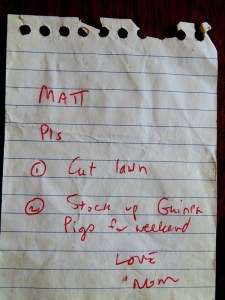
This list of scribbles, once folded
in the middle. A Hansel-Gretel map
of seven words that won’t add up.

It doesn’t say what necklace –
whether to choose, to return,
or have the broken made whole.

And what of the book? Did you
find it, skim a few pages, skip
ahead, decide it wasn’t for you?

Did the title trigger a plan
to run full tilt and dodge
the danger of staying in place?

Your list, if it escaped a pocket or
negligent hand, fell prey to the ditch,
the rough undergrowth of town.

Days outside claimed their toll,
rendered this scrap a relic
whose glyphs baffle and fade.

Maybe you let go on purpose
and reached for better that day –
a story you could read to the end.

Ingrid Ruthig lives on the shore of Lake Ontario, and just east of Toronto. She is the author of Slipstream, Synesthete II, and editor of The Essential Anne Wilkinson and Richard Outram: Essays on His Works. Her work has appeared widely in many Canadian and international publications, including The Best Canadian Poetry, Numéro Cinq, The Malahat Review, and National Post. As a visual artist, she alters existing print language and image to create a fusion in her award-winning textworks, which have been shown in various galleries and are held in private collections. A volume of Ingrid’s poems will be published by Fitzhenry & Whiteside in April 2016.

She can be found at ingridruthig.com

♦♦♦

Up Next:

rolli“One night, coming back from a friend’s, I found my dad lying on his back on the lawn.”

hahnel


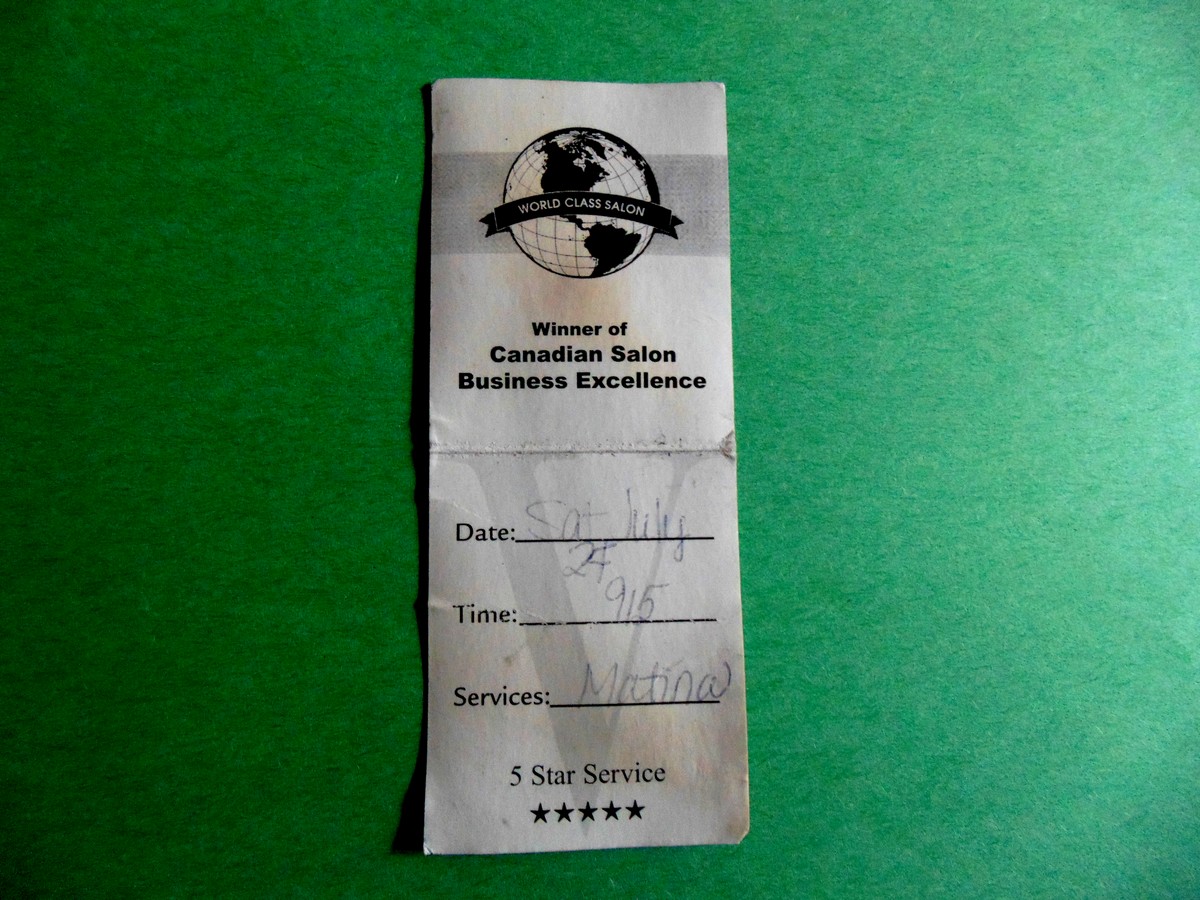
World class salon.

What exactly does that mean, anyway?

Winner of Canadian Salon Business Excellence, Five Star Service. What does that mean?

Kinda thinking it means not very much after this appointment with Matina. Oh, Matina, you’re a nice lady. You’re a skilled conversationalist, and obviously you’ve been working in public service a long time because you have conversation down to a fine art. The listening part of the whole exchange? Not so much.

This is what I say when I come in, pointing to my wild thatch: Trim the ends, not too much off. Reshape the bangs. Cut in some more long layers. You nod. Fine, no problem, you hear this all the time, no doubt. Matina is a pro, I feel confident of this as we talk. We go to the back, and I sink into the sink chair. Water temperature’s perfect, subtle jasmine shampoo scent soothes. You massage my scalp and I melt, almost drift off. Then it’s back to the chair, draped in plastic, and while you comb and snip and comb and snip and comb and snip, we talk.

Oh, do we talk. Movies, relationships, current affairs, travel, books, the economy, the price of groceries, reality TV (my favourite oxymoron), breeds of dogs. You move with acrobatic daring from one topic to the next, faster than I can, and I’m a seasoned talker myself. Before I know it you’re done cutting, and I have forgotten to watch what you’re doing. You’ve succeeded in distracting me. For a second I see your eye flicker from the ends of my hair to my eyes, and I look, too. It looks pretty short. But then it’s supposed to look shorter right after you get it cut, no?

I see, as you blow dry it, that it is not what I asked for at all. It’s the same cut I saw on the lady walking out of here when I came in; it’s the same cut on the other lady you were finishing up with as I flipped through a magazine. It’s the ubiquitous shoulder length bob, it’s the same haircut you gave them. I’ll bet it’s the same damn haircut you give everyone. No, it’s not what I asked for at all.

But I am nothing if not a pragmatist. Hair, once cut, cannot be uncut. I know this to be true. Letting it grow back in is all there is for it. I am a pragmatist and I am also a Canadian. I thank you for the cut. I tip you. And despite my disappointment, I will more than likely, in the fullness of time, make another appointment with you. Because I enjoy good conversation. And because this is a World Class Salon, after all.

Lori Hahnel  is the author of two novels, Love Minus Zero (Oberon, 2008) and After You’ve Gone (Thistledown, 2014), as well as a story collection, Nothing Sacred (Thistledown, 2009), which shortlisted for an Alberta Literary Award. Her work has been nominated for the Journey Prize three times and published in over thirty journals across North America and in the U.K.; her credits include CBC Radio, The Fiddlehead, Joyland and The Saturday Evening Post.  Lori teaches creative writing at Mount Royal University and the Alexandra Writers’ Centre.

She can be found at  www.lorihahnel.ca

♦♦♦

Up Next:

ruthig“… A Hansel-Gretel map
of seven words that won’t add up.”


shenfeld
Good citizen, I sort the trash:
melon rinds, here;
The Sunday Times, vacant
Cheerio boxes, bottles, cans, there.

From Shakespeare’s Hamlet,
Stoppard lifted his confounded courtiers.
The Bard pillaged Saxo,
who…

Spin Procol Harum, you’ll sample Bach.

The mashup maestro counsels,
“Take, mutilate.”

“If I have stood…”

Go ahead—
Steal these words, layer the melody,
release the beat!

“Shoulders of Giants: The Dance Remix?”
Why the fuck not?

Tomorrow, I’ll wrap a potato in
a rocket’s fallen scraps.

Karen Shenfeld  is the Toronto Heliconian Club’s 2015 Writer in Residence. She has three books of poetry published by Guernica Editions: The Law of Return (which won the 2001 Canadian Jewish Book Award), The Fertile Crescentand My Father’s Hands Spoke in Yiddish. Her poetry has also been published in numerous national and international poetry journals. Along with being a poet, Karen is a widely published magazine journalist, editor, and filmmaker. Her indie documentary, Il Giardino, The Gardens of Little Italy, screened at several film festivals, including Planet in Focus. She is currently working on her fourth book of poetry, two documentary films, and a screenplay for a feature, which has been optioned by Canadian director Bruce McDonald.

♦♦♦

Up Next:

hahnel“Matina is a pro, I feel confident of this as we talk.”

yeoman

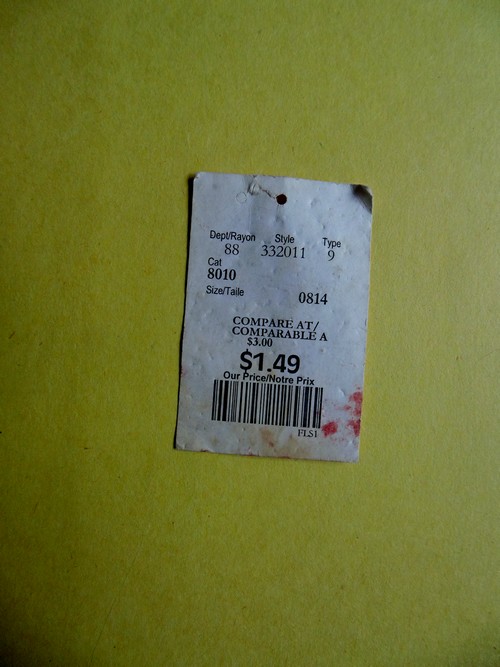
$1.49.
Compare at $3.00.
I wonder what it was.
What can you get for $1.49 these days?
A synthetic scarf or gloves from someplace like Walmart,
that before that came from someplace in Guandong
where vast aisles in even vaster factories
are filled with rows of women in pink smocks putting tags on similar items.
All that work and all that infrastructure and all that fuel to bring it here.

The same day I saw this piece of litter
I was reading about 18th century crimes that could get you transported
to Newfoundland or Australia.
So many thefts of small items of clothing: scarves, gloves, shawls.
It makes you realise
how terribly underclothed the poor were in those days,
how cold they must have been.

The same day I saw this piece of litter
I bought some shrimp at the fish shop on Duckworth Street.
“Is it from here?” I asked.
“It is, but it’s processed and packaged in China” he said.
“Packaged in China and sent all the way back to us?”
“Yes, it’s cheaper that way.”

Elizabeth Yeoman  is a Professor in the Faculty of Education at Memorial University of Newfoundland. Her scholarly work is about language, culture, history and memory. She has also published poetry and travel writing in literary magazines and presented radio documentaries on CBC Radio.

♦♦♦

Up Next:

 
shenfeld“From Shakespeare’s Hamlet,
Stoppard lifted his confounded courtiers.”

bennett

They cannot make sense of it all time and again,
so they create a manual to service their needs.

There is a system of sorts at play here,
that divides the information by group sequentially.

“The damn manual’s a crutch on which we can no longer rely!”
So they fashion radical theories, letting the manual grow stale.

There is a process of sorts in use here,
that groups the divided information periodically.

They cannot lie to others if they will not to themselves,
so they scapegoat the manual, then redact for an eternity.

There is a procedure of sorts at work here,
that informs the groups by division intuitively.

Finally, they cannot keep straight faces when asked to explain,
So they tell it like it is, citing the manual verbatim without knowing.

Jonathan Bennett is a novelist and poet. He is the author of six books, the most recent of which is The Colonial Hotel (ECW Press, 2014). He is a winner of the K.M. Hunter Artists’ Award in Literature. Born in Vancouver, raised in Sydney, Australia, Jonathan lives in the village of Keene, near Peterborough, Ontario.

More at: jonathanbennett.com

♦♦♦

Up Next:

“From above, it was easy to see how the waking world was criss-crossed with delicate bindings that strained to hold it together…”

govier

At first I assume this fell out of an armful of laundry. Is there a laundromat close by? And I’m thinking it was lost on the return trip from the wash, not the outgoing. Fresh.

Either that or the elastic gave out.

But no, it looks intact.

The garment looks very clean. The curb, and the pavement too, look clean, newish, swept. Are we being put on? Is this an art project masquerading as legit Litter? And what about that Ripper-ish shadow leaning over?

I’m becoming suspicious.

It looks a little staged, like a clue. Follow the red panties…

Red underwear is alluring. It spurs the imagination to what lies up that skirt, what lies inside. In old Edo, Japan, the women about town always showed a dash of red beneath their indigo kimono.

Young women wear red panties. I used to, didn’t I? Have a few pair over the years? I remember one. A Valentine purchase. I don’t wear them, anymore. I’m not sure at what age I gave them up. Maybe there was a moment, just as this looks to be a moment, an instant, an impulse, when I thought, the young woman thought, you know what? I’m done with all that.

Katherine Govier’s most recent novel The Ghost Brush is about the daughter of the famous Japanese printmaker, Hokusai, creator of The Great Wave. It has been published in the United States as The Printmaker’s Daughter, and will appear in translation in Spain, Quebec, and Japan.

Katherine’s novel Creation, about John James Audubon in Labrador, was a New York Times Notable Book of the Year in 2003.  She won Canada’s Marian Engel Award for a woman writer (1997) and the Toronto Book Award (1992). She has twice been shortlisted for the Trillium prize.

The author of twelve books, Katherine has been instrumental in establishing two innovative writing programs. In 1989, with teacher Trevor Owen, she helped found Writers in Electronic Residence. Today she is the founder and Director of The Shoe Project working to improve the written and spoken English of immigrant women.

She can be found at www.govier.com

**(‘red knickers’ photo by Allison Howard)

♦♦♦

Up Next:

bennett“They cannot lie to others if they will not to themselves”