Posts Tagged ‘education’

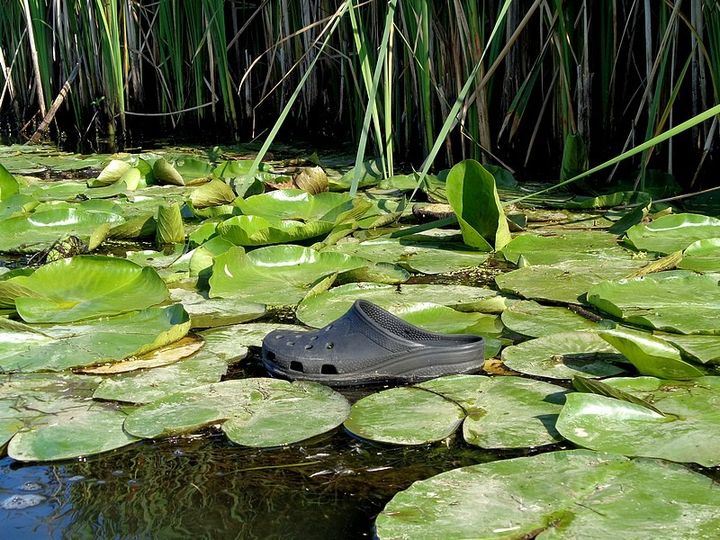
It was scary at first, and hurtful, to be
abandoned. Unmoored, unhinged,
no mate. A fear that all I have left
is entropy, microscopic decline, exhaling
my polyethylene breath, my toxins,
on the napes of my verdant companions,
but I am buoyed by the lilypads’ sibilant
there, there, our rhizomatic exchange.
Look how they embrace the cosmos!
Mired in the ebon deep of the pond, yet
they aspire to the firmament, baring
tender green palms. I trust that, with time,
I can learn from them how to be whole –
how to be not just another empty sole.

Sharon McCartney is the author of eight books of poetry, including, most recently, Hey Trouble and Other Poems (Baseline Press, 2024), Villa Negativa (Biblioasis, 2021) and Metanoia (Biblioasis, 2016). She lives in Victoria, BC.

BONUS… B A C K S T O R Y

I love when a writer is willing to share a glimpse into how a piece of writing came to be. When I sent this photo to Sharon as her ‘prompt’ I expected either poetry or prose in response… she chose poetry then added not only backstory, but a fabulous visual into her process.

“My first thought was poor Croc – where is your mate?! Croc looked so alone out there, floating on the lily pads but, as a loner myself, I know how fruitful solitude can be. So I decided to paint the scene, as a way to explore that. I had recently begun working with a Jungian psychoanalyst, who encouraged me to paint. (Jung was very big on all forms of creativity.) I have never painted in my life... and I have no visual art skills, clearly, but painting is interesting. It’s about letting the unconscious have a hand. What I found with this piece was that the lily pads took over. They’re the focus – the way they straddle darkness and light, feeding on both. As I painted, I found that Croc was the voice I wanted but Croc didn’t need to be in the picture. The lily pads are the way. My analysis is ongoing — I continue to paint and write and unearth..”

~ Sharon McCartney

It’s gone now, buried deep in a midden
or swept down the river: ballracks
and cheek, tympan and gallows, frisket
and forestay: Johannes’ design of 1440.

And the coffin, the box where blackened
type sat, over which he’d lay the platen
to press ink on the vellum, paper made
from the skin of a kid or a lamb softened

in a bath of lime, stretched over a frame
and scraped with a lunellum, a crescent-
shaped blade that removes hair and flesh,
lunellum, yes, from luna, the moon—

can you imagine this? The membrane
of young animals, the moon in someone’s
hand, how deft the skill, thin the vellum,
damp the carbon as a printed page was born.

The allure of our ancestors, right? They had
their day. Me, I’m all toner and cartridge,
gantry and sheet feeder, could do thirty pages 
a minute on a good day. And oh, I had many.

I could join the ancients now, the tide rises so
high, but I cling to this rock, wonder about
my stories and letters now off in the world.
Patient as my forebears, I wait for a word.

~

Lorri Neilsen Glenn is the author and contributing editor of several collections of
poetry, scholarly work and creative nonfiction, including Following the River: Traces of
Red River Women (Wolsak and Wynn) and The Old Moon in Her Arms: Women
I Have Known and Been (Nimbus). Halifax’s first Métis Poet Laureate, she lives and
works in Mi’kma’ki.

Photo credit: Carol Bruneau

On the island of Newfoundland on the southeast tip of the Avalon peninsula in a nearly vacant fishing outport called Beacon’s Lift, there’s a church on the hill that looks out over the whole place and across the North Atlantic. The tide is high, the air is damp and diagonal, and Gord’s square pink house stands its ground like it has for more than a century. But if you were to place your hand on the wall in Gord’s front room, the one with a wood stove and a worn leather daybed and a gilded framed picture of the Sacred Heart, a smaller framed picture of the Angelus, a pair of wool socks hanging over the stove; if you placed your hand on the wall, a stubborn cold would shoot through you, stand up the hair on your arms and neck, shiver your scalp. The howl of the wind through the beams of that house could be straight from the throat of something relentless. And it’s no wonder. It’s no wonder they are always saying the rosary in these parts.

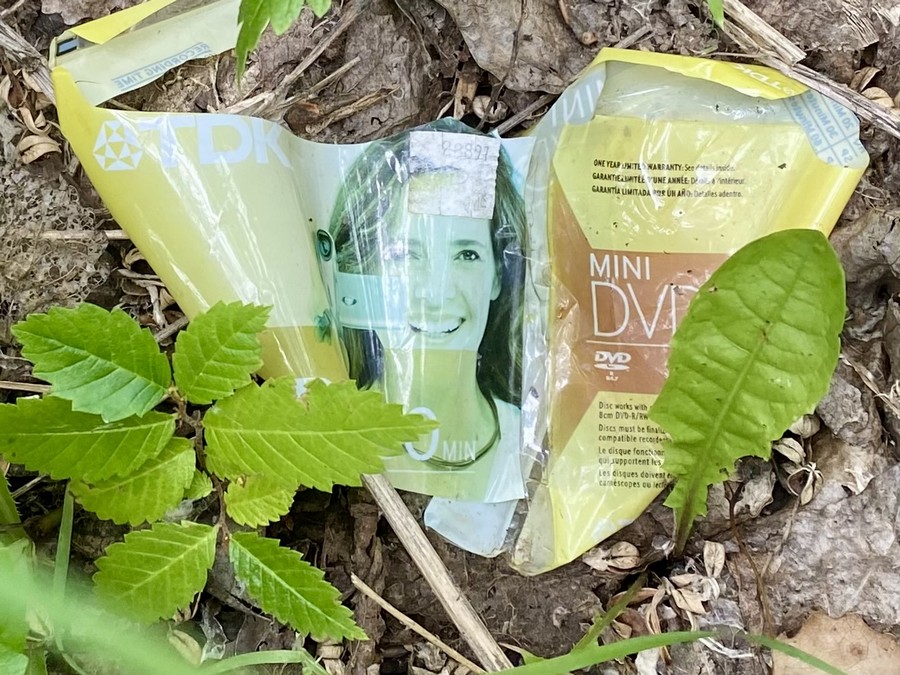
From where did this piece tumble? This bleached face, these bleached teeth with zero minutes. She looks delighted, this one, but I don’t believe her, not for a second. She’s trying to record me, but she’s not looking through the viewfinder. All around her are signs of decay, of rolling right along, of crunchy gossamer underfoot, yet her concern is her teeth.

The new growth appears propped and positioned, like a stand for one of Nan’s fancy plates. The ones she dusts tenderly as if they were dolls.

Fresh, all the same.

Faded, but fresh from flight.

Sara Power is a storyteller from Labrador and a former artillery officer in the Canadian Forces. She completed a Master of Fine Arts in Creative writing at the University of British Columbia. Her writing has appeared in numerous literary journals and anthologies including Best Canadian Stories 2024. She was a finalist for the RBC/PEN Canada New Voices Award, and received a National Magazine Award nomination in the fiction category. Sara’s fiction has won awards from The Malahat Review and Riddle Fence, and has been a finalist at The Toronto Star, The New Quarterly, Prairie Fire, and Fiddlehead. Sara’s first book, Art of Camouflage, is a collection of stories featuring a cast of girls and women caught in the military’s orbit. Originally from Labrador, Sara now lives in Ottawa.

Image courtesy of Angeline Schellenberg.

In this cruellest month,
the icy breeze sparkles
like mica
and hints of glaciers on its breath
as yet another false spring
suffocates under wet snow
as heavy as
three decades of missing you.

A widow’s grief cycles in seasons,
joy brief as summer,
and then too many cold dark days
without your warm grin to turn to,
the sun caught on your freckles,
and in the amber of your eyes.

I ache for you still,
your arms the only true home
I’ve known.
I imagine a life where
we aged together,
celebrated milestones,
laughed about grey hairs
and shared stories –  
a longing as tragic
and futile
as sending messages to Heaven
by balloon.  

♦♦♦

Dymphny Dronyk is a Qualified Mediator and is also a poet, editor, translator, and a story doula. She is passionate about the magic of story and has woven words for money and for love for more than 30 years. She has facilitated unique writing and conflict management workshops across Canada. Her volume of poetry, Contrary Infatuations, (Frontenac House) was short-listed for the Pat Lowther Award and the Stephan G. Stephansson Award for Poetry. She is co-publisher and co-editor at House of Blue Skies Publishing, whose bestselling anthologies include 2014’s The Calgary Project – A City Map in Verse and Visual. Dymphny has served on the boards of the Southern Alberta Brain Injury Society, Writers’ Guild of Alberta, the League of Canadian Poets, and the Creative Nonfiction Collective.

photo credit: Sheree Gillcrist

One of the pleasures of a reading life is how certain pieces stay with us. This is one for me. I adore it for a host of reasons, not least the sly wit, truth wrapped in strained politeness, but also that it reminds me of a process I once went through, trying to say goodbye, using half a note book, each page torn up in turn, before ultimately realizing it came down to a sentence, dropping the key through the letter box, and grabbing a cab to Heathrow. I smile (and cringe a little) at the memory but mostly I love knowing this is how we are, or can be, or have been, women, especially, trying so hard to say, to explain, everything… until we find the courage to say and do the only thing that really matters.

I didn’t remember my Heathrow moment the first time I read this. One of the magicks of re-visiting those pieces that resonate and linger.


** ‘Jay’, originally published, June 2017.

Please re-enjoy!

Jay. I hope you don’t mind that I am just putting the keys in this envelope for you instead of meeting you in person. I know I said I would meet you, but I got a ride tonight so I won’t be here tomorrow after all. I know you said you forgave me, and I really really appreciate it, and I hope you know I really really am sorry for the times I let you down. Also the times you thought I let you down that might not have been actually my fault.

Jay. I am really sorry but I am leaving you the keys here instead of meeting you in person, because I met some guys who can give me a ride most of the way, except they are leaving tonight after their gig (they are a band) so unfortunately I won’t be here tomorrow when you come get these keys. I know that you were pretty mad at me. I really appreciate that you said you would not be mad if I admitted that I didn’t do the stuff I said I would do, which was not fair to you. That is really great. Like, I know I didn’t do the dishes enough and that pissed you off practically every day. So: I did all the dishes before I left! Even the frying pan!

Jay. I’m really truly sorry I won’t be here tomorrow to meet you, but here are the keys. I don’t have the money for the last two weeks of rent because I have to pay these guys gas money, but I’m sure you can find someone to move in on short notice. You can keep my mattress and the clothes in the closet, there are just a few things I couldn’t squish into my bag, I know they won’t fit you but maybe you could sell them. One is my down jacket, the zipper is broken but it’s still really good. You could give it to whoever moves into my room, as part of the deal. If they aren’t vegan.

Jay. I apologize. For everything. I know I said I would meet you in the morning to give you the keys but I am getting a ride with a band tonight – so much cheaper than the Greyhound, only gas and beer money! So I really have to go tonight! I know that in the past me not taking responsibility for my actions was a really big thing for you but since you said if I apologized (really sincerely apologized) (not by text message) you could totally forgive me, I really wanted to be here to meet you and apologize face to face but I have to take this ride. So I hope you don’t mind if I apologize in this note. (This is not a text.) And also I washed the dishes before I left. (I know me not washing the dishes was a thing too.)

Jay. Here are the keys. I’m sorry I won’t be here when we said we would meet, but I have to go. I just have to say I know you were sometimes mad at me but I am basically a good person and it wasn’t my fault that you thought that when we slept together it meant more than it did. I did the dishes. You left a plate and a cup on the counter and I washed them, and the frying pan. (It wasn’t totally fair to say I never did the dishes.) I left you my mattress, I paid $100 for that a year ago on Kijiji so let’s just say that’s $100 of what I owed you for the last two weeks of the month. So if you get someone to move in immediately, you will actually be $100 ahead. Or anyway you’ll have an extra mattress.

Jay. I feel like no matter what I do, it’s not going to make you happy. I know I said I would meet you tomorrow to hand over the keys but I really feel you are going to be mad at me even though you said you would forgive me if I could truly sincerely apologize and take responsibility for my actions, but I think you will actually be happier if I just leave. So with that in mind I have found a ride for tonight so I can’t meet you in the morning, so I am just leaving the keys for you instead. I wish I never slept with you that time because I feel like no matter how many dishes I might have washed or how many times I took out the garbage you would still be mad at me because I’m sorry but I just don’t like you that way, we were both drunk and it was meaningless. I can’t help how I feel, right?

Jay. No matter what I say you will always be mad at me so I’m not going to say anything at all. I am just leaving you the keys.

Jay.

Elise Moser has published short stories; a novel, Because I Have Loved and Hidden It (2009); a YA novel, Lily and Taylor (2013); and a nonfiction book for kids, What Milly Did (2016), which tells the amazing true story of the woman who invented plastics recycling — so the Litter-I-See Project is right up her (litter-strewn) alley! She is a co-organizer of the National Juries and Awards Working Group..

♦♦♦


Biggest Litter Peeve:

Moser:— oh, how to choose just one? I don’t know whether this counts as litter, but if it does: when people throw their still-burning cigarettes on the sidewalk, where anyone, including dogs, might step on it. Cigarette butts, which are made of plastic and take years to decompose, are a related one — people don’t seem to even consider those litter, but they are,

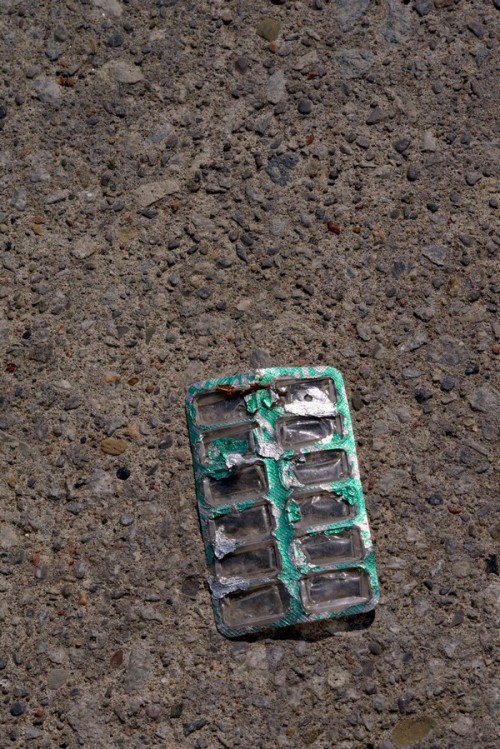
From a picture of an empty gum wrapper, comes ‘xtra care’, the story of a piece of gum tossed into a garbage can on the street, landing on the rim, and being taken, eventually, by a starling to great enough heights to see the beauty of the land before being dropped again on the pavement and being forever changed.

I love the fairy tale quality of this, which reminds me of a series of exquisite chapbooks (The Oldest Cowbird, and The Apple Lovers among them) den Hartog put out in 2023, in the genre she calls Beatrix Potter for grownups. Tiny powerful stories wrapped in a kind of simplicity that sneaks up and astonishes.

Tell me you’ll ever look at gum the same way again.

This is why I continue to run the project. I am honest to god constantly gobsmacked by the alchemy of making amazement from literal rubbish.

** ‘xtra care’ originally published September 2, 2015.

Please re-enjoy.

After he ate his oniony hotdog, he pushed a piece of gum into his mouth. Tasty as the hotdog had been, he wanted something powerfully refreshing to erase it. As he chewed, the gum came to life: zesty, minty, spicy. Twenty minutes later he disposed of it in the garbage, for gum was not recyclable nor compostable, and he cared; perhaps not in an Xtra sort of way, but to a certain extent. He flicked the gum and the empty pack at the stinking, overstuffed garbage can, not noticing as he walked away that the gum had landed on the rim and sat stuck there, a tiny head, watching him go.

All day people passed the fetid garbage can, sometimes flinging rubbish in. Bits of trash tumbled out and merged into the wider city. Bottle caps rolled into the street and were smashed flat like medals won, or coins of unknown currency – something worth something, somewhere. Gauzy produce bags were lifted high and floated until the branches of trees caught them and held them safe from harm. And all through the afternoon and into the dark, quieting night, the little ball of gum sat, as if waiting for the man to return. An emblem of perseverance, of patience. A nod to the everlasting. Gum, after all, was forever.

Come morning, birds emerged before people stumbled from their houses. Flocks of pigeons swooped circles in the sky and then lined themselves up on sleeping rooftops. But it was a starling who landed on the garbage can and jutted its head toward the little ball of gum. Jut-jut, blink-blink. The yellow beak parted and plucked the gum from the bin. Up up up went the gum, clasped tenderly by the bird’s beak.

From above, it was easy to see how the waking world was criss-crossed with delicate bindings that strained to hold it together: roads and rivers and mountain ranges and rows of buildings and lines of cars and banks of wild grasses and hills and valleys of trash that formed patterns indiscernible from down below. Round as the earth, the little ball of gum had never felt less significant, nor more alive, than in those last beautiful moments before he was returned to the street where everything had begun for him. Down down down he was carried. The starling opened his beak and let the little ball of gum fall out onto the pavement, and in no time he had dried and flattened and made a lasting shape of his own. Day after day the people passed over him, including the man who had purchased him and chewed him and somewhat carefully disposed of him. The man never knew of the gum’s journey, and he went whistling through his days until his days ended.

But the gum knew, and would always remember.

Kristen den Hartog is a novelist and non-fiction writer. Her latest book, The Roosting Box: Rebuilding the Body After the First World War, explores war’s profound impact on ordinary people, and the medical innovations and societal changes it spurred. She lives in Toronto and in Lyndhurst, Ontario.

She can be found at www.kristendenhartog.com

♦♦♦

BIGGEST LITTER PEEVE?

Den Hartog: It often occurs to me that “the litter I see” on city sidewalks is garbage for the body as well: chip bags and chocolate bar wrappers and cigarette butts. Things that shouldn’t have gone in in the first place! Though admittedly I’m guilty of the odd junk-food binge….